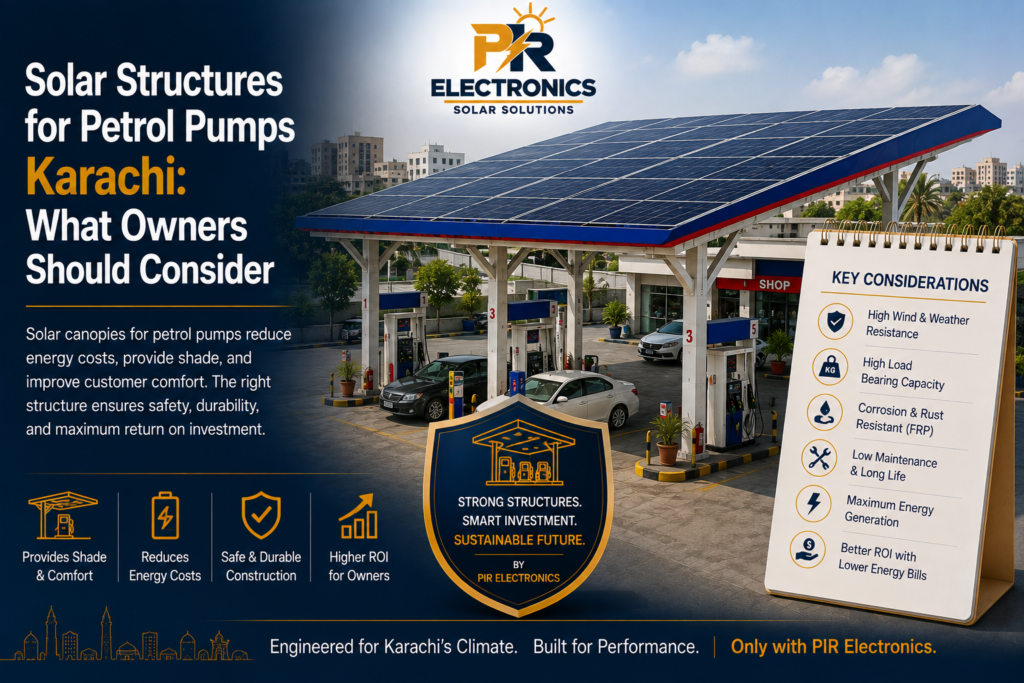
Petrol pumps operate for long hours and depend on electricity for lighting, fuel dispensers, offices, security systems, signage, air compressors, and other equipment. This makes solar energy an attractive option for reducing daytime electricity costs.
However, installing solar at a fuel station is not the same as placing panels on an ordinary house roof.
A well-designed solar structures for petrol pumps Karachi project must consider canopy strength, wind exposure, vehicle movement, existing electrical equipment, corrosion, maintenance access, and safety around an active commercial solar structures Karachi site.
For petrol pump owners, the quality of the mounting structure is just as important as the choice of solar panels.
Table of Contents
Why Petrol Pumps Are Suitable for Solar
Fuel stations often have large canopy areas directly above filling bays. These surfaces receive good sunlight and may already cover a significant portion of the property.
Solar panels can also be installed on office roofs, service buildings, or separate elevated structures where suitable.
A petrol pump solar mounting system can help make better use of these existing surfaces without consuming additional land.
Potential applications include powering:
- Forecourt lighting
- Office equipment
- CCTV systems
- Digital signage
- Air compressors
- Convenience-store loads
- Water pumps
- Daytime auxiliary systems
The final solar capacity depends on available space, electrical demand, shading, and structural feasibility.
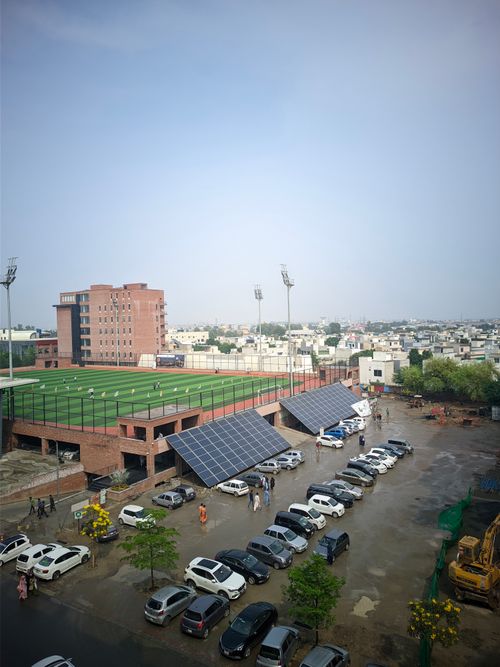
Existing Fuel Canopies Need Assessment First
A petrol pump canopy may look strong, but appearance alone does not confirm whether it can support additional solar loads.
Before mounting panels, the existing canopy should be assessed for:
- Structural condition
- Age of the canopy
- Existing corrosion
- Column condition
- Beam spacing
- Roof-sheet condition
- Previous modifications
- Available load capacity
- Drainage arrangements
The U.S. Department of Energy notes that PV mounting structures must support the array and resist environmental loads such as wind and weather over the life of the system.
For solar structures for petrol pumps Karachi, this means the solar frame should not simply be attached wherever space appears available.
Wind Loads Matter on Open Petrol Pump Sites
Fuel stations are usually open on several sides. This allows vehicles to move freely, but it can also expose elevated solar structures for petrol pumps Karachi to wind from multiple directions.
Solar panels can experience uplift forces, particularly when mounted above a canopy or on raised frames.
A properly designed solar canopy structure should consider:
- Structure height
- Panel tilt
- Module dimensions
- Column spacing
- Wind direction
- Bracing
- Connection strength
- Anchoring
- Canopy geometry
Higher structures may face greater wind demand, so installers should not increase elevation on-site without reviewing the structural design.
Corrosion Can Become a Long-Term Issue
Karachi’s humidity, dust, coastal conditions, and industrial pollution can affect metal components over time.
Petrol stations located near the coast or in areas with heavy traffic may experience additional environmental exposure.
Conventional steel structures can perform well when properly protected, but damaged coatings, cut edges, bolts, and welds may require maintenance.
This is one reason FRP solar structures can be considered for certain applications.
Fiber-reinforced polymer does not rust through the same electrochemical process as conventional carbon steel. It is also relatively lightweight and electrically non-conductive.
However, FRP is not automatically suitable for every petrol pump. Profile size, resin quality, UV resistance, connection design, fire requirements, and actual structural loads must all be evaluated.
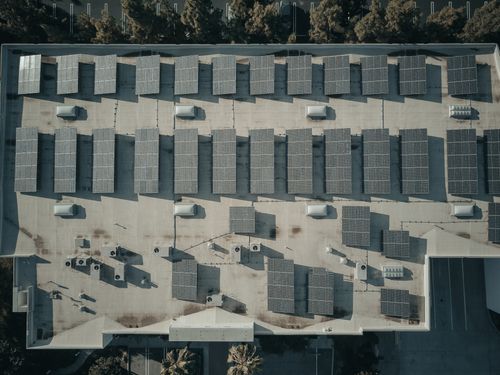
Why Lightweight Structures May Be Useful
Existing petrol pump canopies were originally designed for specific loads.
Adding heavy solar frames can increase dead load on beams and columns.
A lightweight mounting system may help reduce additional structural demand.
This can make FRP solar structures attractive where canopy capacity is limited, provided engineering requirements are satisfied.
Lower structural weight may also make transportation and installation easier, especially where the pump must remain operational during the project.
But lightweight does not mean weakly secured.
Wind forces still need to travel safely through the panels, rails, supports, fasteners, and canopy structure.
Keep Vehicle Clearance in Mind
Petrol stations serve different types of vehicles, including cars, vans, delivery vehicles, and occasionally larger commercial solar structures Karachi traffic.
Any petrol pump solar mounting design must preserve safe clearance.
Structures should not interfere with:
- Fuel tanker movement
- Customer vehicles
- Delivery trucks
- Signboards
- Canopy lighting
- Fire equipment
- Access to fuel dispensers
Column placement is particularly important if new independent solar canopies are being added.
A poorly positioned support can create a collision risk or reduce usable forecourt space.
Fire and Electrical Safety Must Be Considered
Petrol pumps are specialised commercial environments.
Solar-system design should be coordinated with existing electrical and safety requirements.
Cable routing should remain controlled, protected, and clearly separated from areas where vehicles or maintenance activities could damage wiring.
The National Fire Protection Association provides guidance on photovoltaic electrical and fire-safety considerations, including system access and emergency response.
For petrol stations, electrical installation should be handled by competent professionals who understand both solar systems and the specific hazards of the site.
Maintenance Access Should Be Planned Early
A petrol pump solar system will need cleaning, inspection, and occasional repairs.
Panels should not be packed so tightly that technicians cannot safely access modules, wiring, or structural connections.
A good commercial solar structures Karachi design should leave room for:
- Module cleaning
- Clamp inspection
- Cable checks
- Drainage maintenance
- Panel replacement
- Structural inspection
- Roof-sheet repairs
Maintenance access is easier to provide during design than after the complete array has been installed.
Drainage Around Solar Canopies
Petrol pump canopies must already manage rainwater.
Adding solar modules can change how water flows across the canopy.
Panel rows, rails, and mounting points should not block gutters or drains.
A solar canopy structure should consider:
- Existing roof slope
- Water channels
- Downpipes
- Panel gaps
- Drain locations
- Areas where debris may collect
Poor drainage can lead to standing water, roof leakage, or corrosion around metal components.
Should Panels Be Mounted Flat?
Very low panel tilt may reduce structure height and visual impact, but it can also make dust accumulation and water drainage more difficult.
Karachi receives significant dust throughout the year, so panel angle should balance solar performance, wind considerations, structural design, and maintenance needs.
There is no single correct angle for every fuel station.
Site-specific assessment is more reliable than copying another petrol pump’s layout.
What Should Petrol Pump Owners Ask Before Installation?
Before approving solar structures for petrol pumps Karachi, owners should ask:
- Has the existing canopy been assessed?
- What additional load will the system create?
- How has wind loading been considered?
- What material is being used?
- How will the structure resist corrosion?
- Will vehicle clearance remain safe?
- How will cables be routed?
- Are drains still accessible?
- Can panels be cleaned safely?
- What maintenance is required?
A detailed technical proposal provides more confidence than choosing only by price per kilowatt.
How PIR Electronics Can Support Petrol Pump Projects
PIR Electronics provides solar site surveys, feasibility planning, FRP petrol pump solar mounting structures, structure installation, and panel mounting services.
For fuel stations, the design process should begin with the actual site rather than a standard frame.
The team can review canopy conditions, available space, access, mounting options, and the practicality of lightweight FRP-based structures where appropriate.
The objective should be a mounting solution that supports solar generation without compromising daily petrol pump operations.
Final Thoughts
Petrol pumps offer excellent opportunities for solar generation, but the structure supporting the system needs careful planning.
Successful solar structures for petrol pumps Karachi projects combine solar canopy structures assessment, lightweight design where appropriate, wind resistance, corrosion protection, vehicle clearance, and safe maintenance access.
For fuel-station owners, investing in the right mounting structure can help protect both the solar system and the existing property for years to come.
Planning solar for a petrol pump in Karachi? Contact PIR Electronics for a site survey and mounting-structure feasibility assessment before finalising your installation.
FAQs
Can Solar Panels Be Installed on Existing Petrol Pump Canopies?
Yes, but only after confirming that the canopy is structurally suitable for the additional load.
Are FRP Structures Suitable for Petrol Pumps?
They may be suitable where low weight and corrosion resistance are valuable, but structural and fire-related requirements must be considered for the specific project.
Can Solar Be Installed Without Using the Existing Canopy?
Yes. Independent solar canopies or nearby building roofs may also be considered where sufficient space is available.
Do solar structures for petrol pumps Karachi Need Regular Inspection?
Yes. Clamps, bolts, supports, cables, drainage, and visible structural condition should be checked periodically.
Can a Petrol Pump Stay Open During Installation?
Often yes, but the work should be phased carefully to maintain safe vehicle and customer movement.