

Solar structures are expected to support panels reliably for years, but structural performance is not determined by material strength alone. The shape, length, support arrangement and applied compression can influence how a member behaves under load.
That makes FRP Buckling Stability Karachi an important engineering consideration for modern rooftop solar structures.
Recent research on pultruded GFRP members is increasingly focused on the interaction between crushing, local buckling and global buckling. A 2026 study examined 635 experimental tests while developing improved approaches for these interacting failure modes.
Table of Contents
What Buckling Means for FRP Structures
Buckling occurs when a structural member becomes unstable under compression or bending before its material reaches its theoretical maximum strength.
For FRP Member Stability Karachi, this distinction matters because composite profiles behave differently from conventional steel sections. FRP is anisotropic, meaning its properties vary with fibre direction, while many pultruded profiles also contain relatively thin walls.
A member can therefore have adequate material strength but still require careful stability assessment.
Research published in 2025 found that GFRP members can experience complex interactions between local and global buckling, making stability a key part of structural design.
Why Member Length Matters
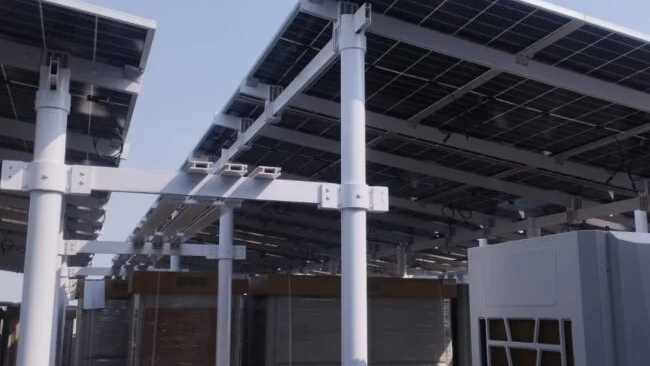
FRP Member Stability Karachi depends partly on the relationship between member length and cross-section properties.
A short compression member and a long slender member may use the same FRP material but behave very differently.
As length increases, lateral instability can become increasingly important. Support spacing also affects how freely a member can deflect or rotate.
This is why FRP Buckling Design Karachi should consider the complete structural arrangement rather than simply checking the nominal strength of an individual profile.
For solar structures, engineers need to evaluate the actual span, support points, applied loads and section geometry together.
Local and Global Buckling Are Different
FRP Buckling Design Karachi can involve two important forms of instability.
Local Buckling
Local buckling occurs when a relatively thin wall or part of a cross-section becomes unstable.
Global Buckling
Global buckling involves movement of the complete structural member, such as lateral or flexural buckling.
The distinction matters because the two mechanisms can require different design checks.
A 2026 study in the Journal of Composites for Construction notes that the orthotropic nature of pultruded GFRP makes these members susceptible to local buckling and that material-property variation can affect buckling calculations.
Why Geometry Still Matters Without Discussing Dimensions
FRP Solar Load Stability Karachi is not simply a question of how thick a profile looks.
Cross-section shape, stiffness distribution and slenderness all influence stability.
Research published in 2025 on pultruded GFRP elements found that cross-section configuration and stiffening can substantially influence critical buckling behaviour. In that study, internal stiffeners increased calculated global buckling load by up to 100% for the investigated hollow sections.
The result reinforces an important engineering principle: structural geometry should be selected according to the expected load path.
Imperfections Can Influence Capacity
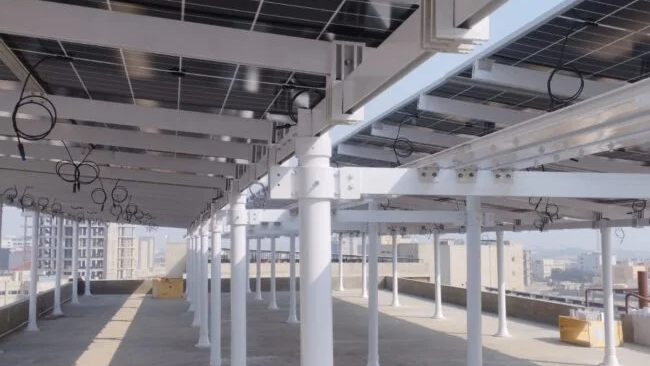
Real-world composite profiles are not perfectly straight or perfectly uniform.
Small initial imperfections can influence the point at which instability develops. Recent research on GFRP trusses found that geometric imperfections could reduce predicted maximum load capacity by up to 25% in the tested configurations.
This makes FRP Buckling Stability Karachi relevant during both design and quality assessment.
It also means that FRP Member Stability Karachi should consider realistic structural behaviour instead of relying only on idealized computer models.
Designing for Solar Loads
Solar structures experience permanent panel loads together with wind and other service loads.
For FRP Solar Load Stability Karachi, engineers should establish the expected load combinations before selecting the structural profile.
The analysis should then examine compression, bending, support conditions and potential instability.
This is where FRP Buckling Design Karachi becomes part of the overall structural process. The objective is not simply to select a strong material. It is to develop a stable load-bearing system.
For specialist FRP solar structures, PIR Electronics can help businesses evaluate composite structural solutions according to their intended solar application.
Why This Is Becoming a Bigger FRP Design Issue
Recent research is moving toward more sophisticated GFRP stability assessment rather than treating buckling as an isolated calculation. New design work is specifically addressing interactions between local buckling, global buckling and crushing.
That trend makes FRP Member Stability Karachi increasingly relevant as composite structures move into more demanding structural applications.
For Karachi rooftop projects, FRP Solar Load Stability Karachi should therefore be considered during structural planning, not only after installation.
FAQs
What is FRP buckling?
FRP Buckling Stability Karachi refers to the ability of an FRP structural member to resist instability when subjected to compression or bending loads.
Why does member stability matter for solar structures?
FRP Member Stability Karachi matters because member length, support conditions, cross-section behaviour and applied loads can influence structural stability even when the material itself has adequate strength.
What is FRP buckling design?
FRP Buckling Design Karachi involves assessing potential local and global instability alongside the member’s strength, geometry, stiffness and loading conditions.
What affects solar-load stability?
FRP Solar Load Stability Karachi depends on factors including load combinations, member slenderness, support conditions, cross-section behaviour and potential imperfections in the structural system.