
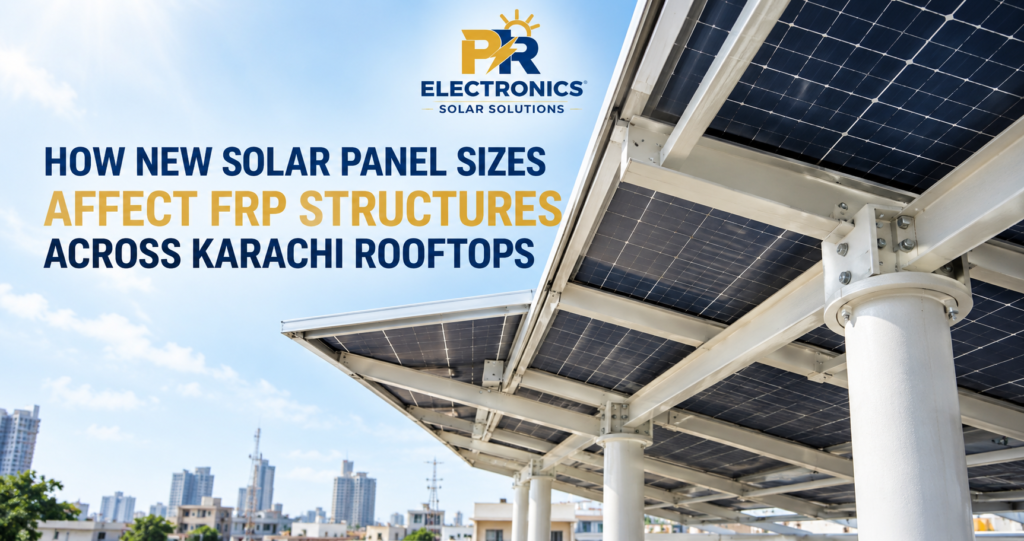
Solar panels are getting bigger, more powerful and more varied. That change is creating a practical issue that many buyers overlook: the structure underneath the panel must match the panel being installed.
For Karachi rooftops, FRP Panel Compatibility Karachi is therefore becoming an important consideration when selecting a new solar structure.
The solar industry has moved from older 156 mm and 166 mm cell formats toward larger 182 mm and 210 mm formats. Current industry research also shows growing use of rectangular wafer formats.
That means the right FRP Solar Structure Fit Karachi cannot be decided simply by looking at the panel’s wattage.
Table of Contents
Why Solar Panel Sizes Are Changing
Modern manufacturers are increasing panel power partly by using larger cell formats. Trinasolar reported that cumulative shipments of its 210 mm products had exceeded 170 GW by early 2025, showing how quickly larger-format technology has entered the market.
For FRP Panel Compatibility Karachi, this matters because panel dimensions, frame positions and mounting points can vary between generations.
A 550W panel and a 600W panel may not have exactly the same physical dimensions.
Therefore, FRP Panel Mounting Karachi should start with the actual panel specifications rather than only its wattage.
What Panel Compatibility Actually Means
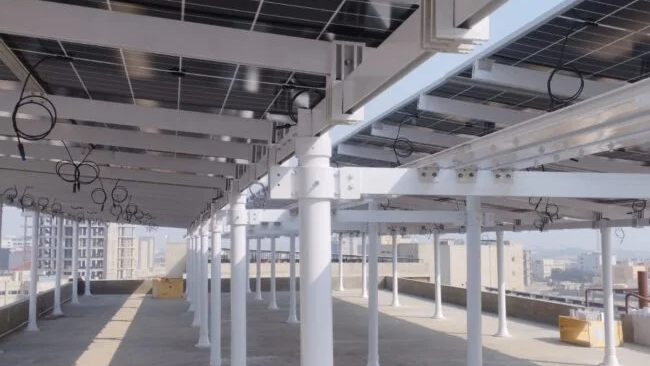
FRP Solar Frame Karachi compatibility means that the structure can properly accommodate the selected panel and its approved mounting method.
The installer should check the panel’s length, width, frame thickness, clamp zones and mounting instructions.
This is where FRP Solar Structure Fit Karachi becomes important.
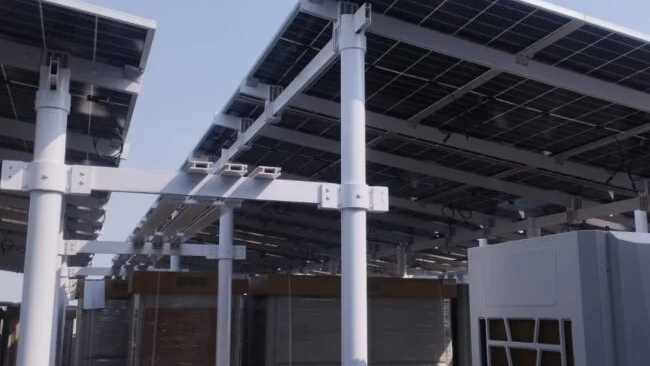
The structure should provide appropriate support for the selected modules without forcing installers to use unsuitable attachment points or improvised mounting methods.
For FRP Panel Compatibility Karachi, matching the panel and structure before installation can prevent avoidable changes later.
Larger Panels Need the Right FRP Structure
Modern large-format panels can have substantially different dimensions from older modules.
Industry roadmaps show the continuing movement toward 182 mm and 210 mm wafer formats, while rectangular formats are also becoming more important.
For FRP Panel Mounting Karachi, this means buyers should provide the exact panel model before ordering the structure.
The same principle applies to FRP Solar Frame Karachi selection. A structure should be selected around the actual panel and mounting arrangement instead of assuming that every solar module uses identical dimensions.
Why This Matters for Karachi Buyers
Pakistan’s solar market is expanding rapidly. Renewables First reported 4.9 GW of net-metered solar capacity by March 2025, while later estimates put Pakistan’s overall deployed solar capacity considerably higher because much behind-the-meter generation is not captured in official statistics.
As more panels enter the market, FRP Panel Compatibility Karachi becomes increasingly relevant for new installations and replacements.
A proper FRP Solar Structure Fit Karachi assessment can make sure the selected structure works with the specific modules being purchased.
What to Confirm Before Ordering
Before purchasing an FRP Solar Frame Karachi solution, buyers should provide the panel datasheet and confirm the physical dimensions.
The installer should check:
- panel length and width;
- frame dimensions;
- approved clamp positions;
- mounting-hole information where applicable;
- panel orientation;
- required support arrangement.
These basic checks make FRP Panel Mounting Karachi much easier and reduce the possibility of discovering a compatibility problem after the structure has already been installed.
For specialist FRP solar structures, PIR Electronics can help customers evaluate their panel specifications and select an appropriate FRP structure for the installation.
The Panel Should Be Selected Before the Structure
A common purchasing mistake is ordering the structure first and selecting panels afterward.
That approach can create unnecessary complications.
For FRP Solar Frame Karachi projects, the better sequence is straightforward: select the panel, confirm its dimensions and mounting requirements, then match the FRP structure.
This approach improves FRP Solar Structure Fit Karachi and gives the installer clearer information before fabrication or installation begins.
It also makes FRP Panel Compatibility Karachi easier to verify from the beginning.
Why This Trend Will Continue
Solar module technology is continuing to evolve. Industry research shows manufacturers moving toward larger and rectangular cell formats, while high-power modules are becoming increasingly common.
That makes FRP Panel Mounting Karachi a subject worth considering whenever a new generation of solar panels is selected.
The basic FRP structure does not need to become complicated. It simply needs to match the equipment it is supporting.
For Karachi property owners, checking FRP Solar Frame Karachi compatibility before purchasing can save time, avoid installation changes and create a cleaner final solar installation.
The key is simple: choose the panel first, verify its dimensions, and then select the FRP structure around it.
FAQs
Why does panel size matter for an FRP structure?
Different solar panels can have different dimensions and mounting requirements. FRP Panel Compatibility Karachi ensures the selected structure matches the actual module being installed.
Are newer solar panels getting larger?
Yes. The industry has increasingly moved toward larger 182 mm and 210 mm cell formats, along with rectangular formats. This makes FRP Solar Structure Fit Karachi more important when selecting mounting structures.
What should I check before buying an FRP structure?
Confirm the panel’s dimensions, frame specifications and approved mounting zones. These details help determine suitable FRP Panel Mounting Karachi requirements.
Can PIR Electronics provide an FRP structure for different panels?
The appropriate FRP Solar Frame Karachi solution depends on the selected panel and installation requirements. PIR Electronics can assess the project information and determine a suitable FRP structure.