
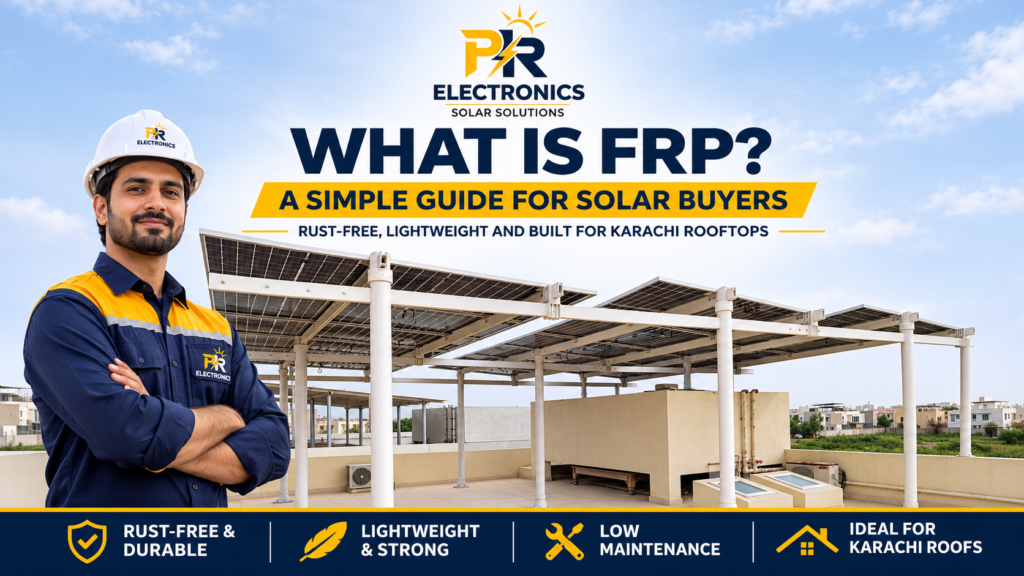
If you are buying a solar system, you will hear a lot about panels, inverters and batteries. You will hear far less about the structure that holds the panels up and that is strange, because the structure is the one part that has to survive everything Karachi throws at it, for as long as the panels themselves last. This guide answers one question what is FRP? in plain words: what it is, why it matters for a rooftop in Karachi, and what to ask before you buy.
Table of Contents
FRP in One Sentence
So what is FRP? FRP stands for fiber-reinforced polymer. In everyday language, it is fiberglass: fine glass fibers held together in a tough resin. The fibers give it strength. The resin holds the fibers in shape and protects them from the weather. Together they make a material that is strong, light, and the part that matters most in Karachi does not rust.
Think of it like reinforced concrete, only the other way round. In concrete, steel bars give strength to a material that would otherwise crack. In FRP, glass fibers give strength to a resin that would otherwise be brittle. The result is a composite: a material made of two things, better than either one on its own.
Why Solar Buyers in Karachi Should Care
Your panels are built to live for decades. The question PIR Electronics asks every buyer is a simple one: your panels live 25 to 30 years what about the structure holding them?
Karachi is hard on metal. Sea breeze carries moisture and salt across the city, from Clifton and Defence to Korangi and beyond. Humidity sits in the air for much of the year. Industrial areas add their own share of corrosive deposits. Steel, even galvanized steel, fights a losing battle in those conditions. The coating wears at joints, bolt holes and scratches from installation, and rust starts exactly where you cannot see it inside the joint.
FRP does not have that problem, because there is no iron in it to rust. It is corrosion-resistant by nature, not by coating. There is nothing to repaint, nothing to treat, and no slow weakening at the joints from rust eating the metal away. If you are comparing quotes, understanding what is FRP and what it is not is the first step.
What Is FRP Made Of, and Why That Matters
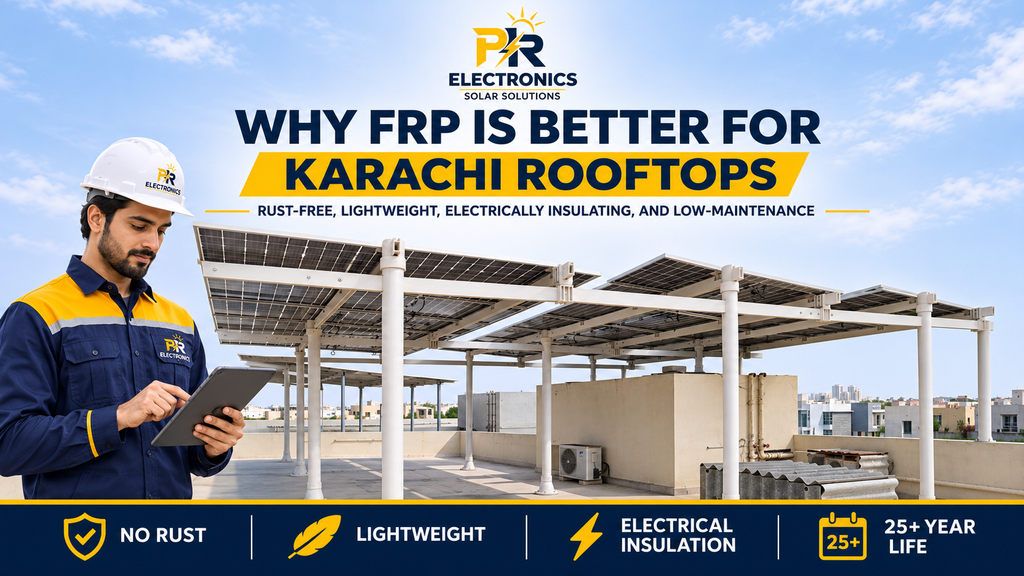
A solar structure made from FRP is not a plastic frame. The glass fibers inside it carry the load, the way steel carries the load in a steel frame. The resin binds those fibers together and seals them against water, salt and sun.
Three properties of that combination matter on a rooftop:
- It does not corrode. Salt air, rain and humidity do not rust fiberglass. A structure that never rusts never needs repainting, and never thins at its joints.
- It is light. FRP weighs far less than steel for the same job. That means less load on your roof slab, which matters most on older roofs and on large commercial rooftops where every extra kilo counts.
- It insulates. Fiberglass does not conduct electricity the way steel does, and it does not carry heat the same way either. On a rooftop full of electrical equipment, that insulation is a genuine safety margin, not a marketing line.
None of this means FRP is soft or flimsy. The same family of materials is used in boats, chemical plants and other places where strength and corrosion resistance have to live together. A solar structure is a demanding job, and FRP was made for demanding jobs.
How Long Does It Last?
A well-made FRP structure is designed to last 25 years or more the same lifespan as the panels it holds. That is the whole point. With a steel structure, many owners find themselves paying for the structure twice: once when it is installed, and again when rust forces a replacement while the panels still have a decade of life left. With FRP, one structure is meant to serve for the life of the system.
That is the whole point of asking what is FRP before you buy.
That long life also changes the maintenance picture. A steel frame needs repainting and treatment every few years, and each round costs money and disruption. An FRP frame needs no corrosion maintenance at all. It still needs checking joints, bolts and alignment should be looked at as part of normal system care but nobody is ever repainting it to keep it alive.
Is It Strong Enough for Karachi Wind?
This is the fairest question a buyer can ask, and it deserves a straight answer. Strength is not about the material alone. It is about engineering: the right design, for the right roof, for the right wind conditions.
PIR Electronics designs its FRP structures for local wind conditions, rated up to 160 km/h. That rating comes from site-engineered design the structure is planned for the actual roof and the actual wind zone, not copied from a generic drawing. A strong material in a weak design is still a weak structure. A properly engineered FRP structure, on the other hand, is built to hold firm through the gusts Karachi sees in storm season.
When you compare quotes, ask how the structure was engineered, not just what it is made of. The answer tells you more than the material name ever will.
So when you ask what is FRP, ask how it was engineered too the design matters as much as the material.
FRP vs Steel: The Honest Comparison
Neither material is perfect for every job, so here is the comparison without the sales talk:
- Rust: Steel rusts in coastal air and needs repainting. FRP never rusts.
- Weight: Steel is heavy and adds load to the roof. FRP is light and eases it.
- Life: Steel often needs replacement before the panels die. FRP is designed to match panel life.
- Maintenance: Steel needs regular corrosion care. FRP needs none for corrosion.
- Safety: Steel conducts electricity. FRP insulates.
- Cost: Steel usually costs less on day one. FRP usually costs less over the full life of the system, once repainting and replacement are counted.
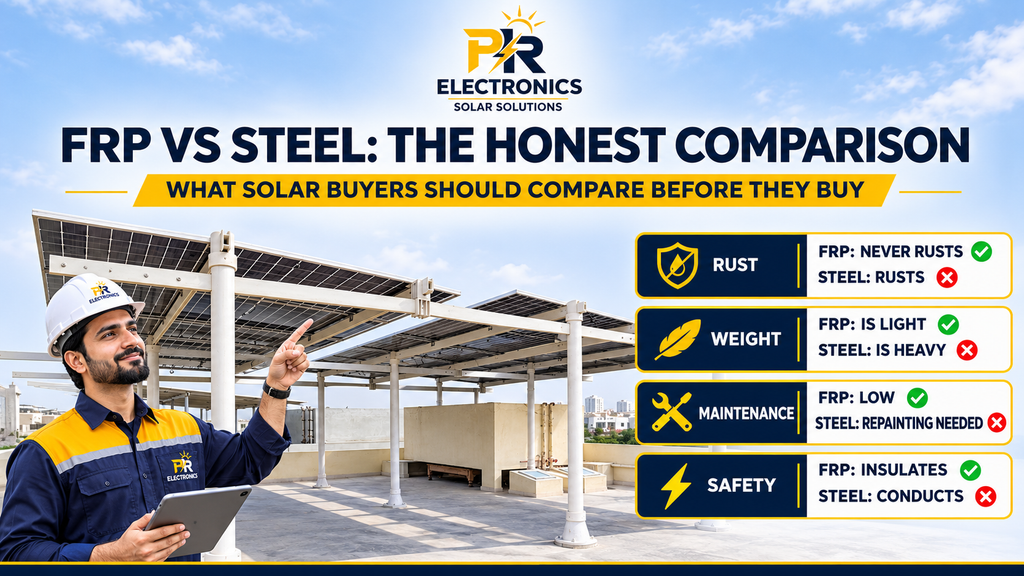
If you are still wondering what is FRP, the comparison above is the short answer: the same job, without the rust.
The day-one price is real, and it is fair to weigh it. But a structure is a 25-year purchase. Judged over 25 years, the cheaper frame is not always the cheaper choice.
What to Ask Before You Buy
Whether you choose FRP or steel, ask your installer these questions before you sign anything:
- Is the structure site-engineered? A design made for your roof and your wind zone is very different from a one-size-fits-all frame.
- What is the wind rating? Look for a rating that covers the strong gusts Karachi gets, and ask what it is based on.
- How long is it designed to last? If your panels are built for 25 years or more, your structure should be designed for the same horizon, not half of it.
- What maintenance will it need? Get the repainting and treatment schedule in writing for steel, and the inspection schedule for FRP.
- How are the joints protected? Joints and bolt points are where corrosion and fatigue start. With FRP, the corrosion question is answered by the material itself.
A good installer welcomes these questions. They are the questions of a buyer who understands that the frame is not an accessory it is the foundation the whole system stands on.
The Bottom Line
So what is FRP, in short? Fiberglass: glass fibers for strength, resin for protection, combined into a structure that does not rust, weighs less, insulates electrically, and is designed to last as long as the panels it holds. For a coastal city like Karachi, that combination is not a luxury. It is the practical answer to the oldest problem in solar structures: the panels outlive their own frame.
Buying a new solar system, or replacing a rusted structure? Call PIR Electronics at 0308-1889998 or visit pirelectronics.com. Site-engineered FRP solar structures, designed for Karachi no rust, no repainting, 25 years or more.