
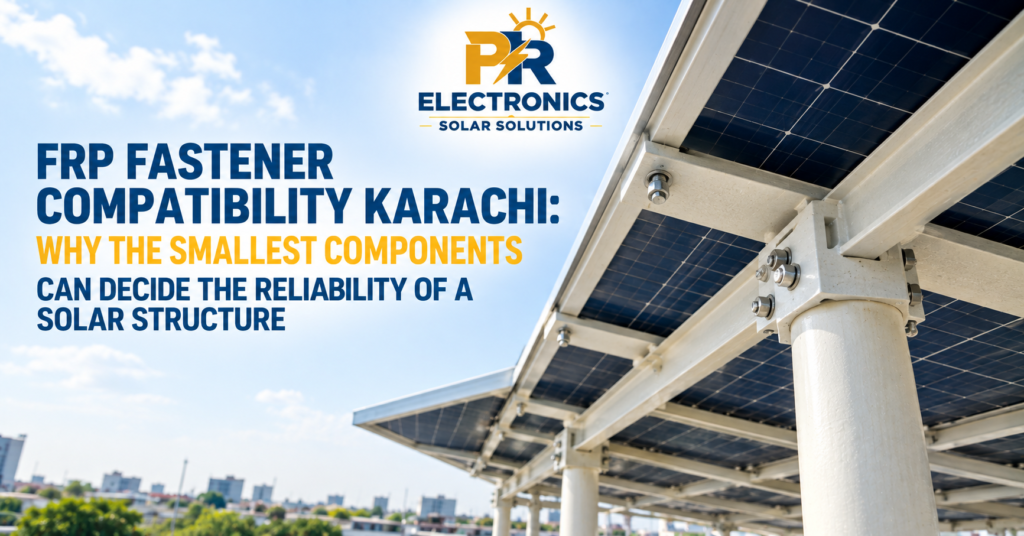
Solar mounting discussions usually focus on the profile, panel weight, wind resistance and corrosion. Yet one of the most important parts of a composite structure often receives far less attention: the connection.
Bolts, nuts, washers and connection plates transfer loads between structural members. In an FRP solar system, these components do not simply hold the structure together. They influence how forces move through the composite, how stress concentrates around holes, and how the joint behaves over years of outdoor exposure.
That makes FRP Fastener Compatibility Karachi a serious engineering consideration rather than a purchasing detail.
Recent research reinforces this point. A 2026 experimental study tested 62 bolted GFRP/steel joints and found that section geometry, tightening torque and washer geometry significantly influenced joint behaviour.
For Karachi solar installations, that research matters because the connection sits directly between the composite structure and the environmental forces acting on the array.
Table of Contents
Why Fasteners Matter in FRP Structures
Steel structures and FRP structures do not respond to connections in exactly the same way.
FRP has anisotropic behaviour, meaning its strength and stiffness can vary according to fibre direction. It also handles concentrated loads differently from homogeneous metals.
A bolt applies force over a relatively small area. Without appropriate washers, hole geometry and tightening practice, that local force can create excessive stress around the connection.
This makes FRP Bolted Joint Karachi design an important part of structural planning.
A properly designed connection distributes the load across the FRP profile instead of allowing the bolt to create a severe local stress concentration.
The Washer Is Not Just a Spacer
The role of the washer deserves particular attention.
A washer increases the bearing area around the bolt and helps distribute clamping pressure across the composite.
Recent experimental work on pultruded GFRP/steel joints found that washer geometry and tightening torque significantly affected joint performance.
That makes FRP Washer Design Karachi more than a minor installation choice.
The washer diameter, thickness, stiffness and contact area should suit the FRP profile and the expected load.
An oversized or unsuitable washer can create its own installation problems, while an undersized washer may fail to distribute force effectively.
Why Tightening Torque Requires Control
Metal bolts tolerate high clamping forces differently from composite profiles.
If an installer applies excessive torque to an FRP connection, the bolt does not automatically become “safer.”
Instead, excessive local compression can damage the composite around the hole, distort the profile or introduce stresses that reduce long-term joint performance.
Research published in 2026 specifically examined tightening torque and bolt preload in pultruded GFRP/steel joints and identified their influence on load capacity and failure behaviour.
For FRP Fastener Compatibility Karachi, torque specification should therefore form part of the installation procedure rather than remain dependent on individual worker preference.
Hole Preparation Can Affect Joint Strength
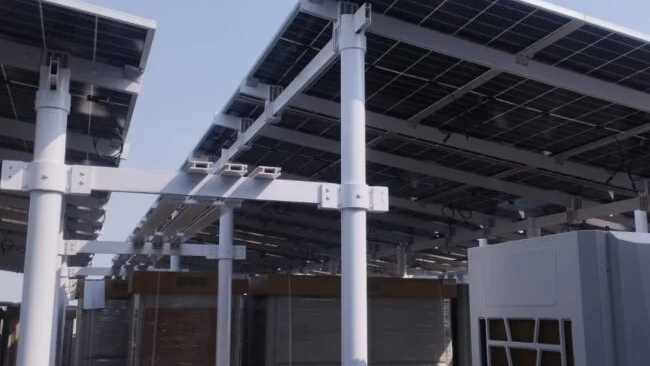
The hole itself becomes part of the structural system once a bolt passes through it.
Drilling can alter the local composite structure, particularly if installers use unsuitable tools, excessive force or incorrect hole dimensions.
Research into GFRP bolted joints identifies bolt-hole clearance, edge distance, bolt diameter, washer size and drilling conditions among the parameters that influence joint behaviour.
That makes FRP Bolted Joint Karachi planning inseparable from fabrication quality.
The manufacturer should ideally define hole dimensions and installation methods before the structure reaches the rooftop.
Load Transfer Is the Real Objective
A successful connection does not simply keep two components touching.
It transfers structural forces from one member to another without creating unacceptable local damage.
This makes FRP Joint Load Transfer Karachi a useful way to think about composite mounting design.
- Wind acts on the panels.
- The panels transfer forces to clamps.
- Clamps transfer forces to rails and profiles.
- Profiles transfer forces through the bolted joints.
- The joints then transfer those loads into the supporting structure and, ultimately, the roof.
- Every connection forms part of that load path.
If one connection concentrates excessive stress or allows movement, the consequences can extend beyond the individual bolt.
Edge Distance Changes the Failure Mode
The distance between a bolt hole and the edge of an FRP profile has a major influence on joint behaviour.
Recent 2025 research on strengthened GFRP bolted joints found that limited edge distance can significantly reduce joint capacity and increase the risk of failure around the connection.
This is one reason FRP Washer Design Karachi cannot be separated from profile geometry.
A large washer cannot compensate for an inherently poor hole position.
The structure needs adequate edge distances, appropriate bolt spacing and a connection geometry designed for the expected loads.
Coastal Karachi Adds Another Layer
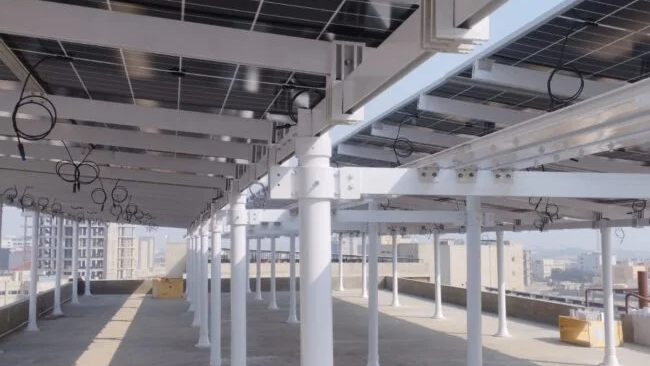
Karachi introduces environmental factors that make fastener selection even more important.
Humidity, salt-laden air and moisture can accelerate corrosion in exposed metallic components.
The U.S. Department of Energy specifically warns that solar PV systems commonly combine stainless-steel fasteners, aluminium frames and steel support members, creating situations where inappropriate material combinations can contribute to galvanic corrosion and affect long-term reliability.
That gives FRP Fastener Compatibility Karachi another dimension.
The question is not only whether the FRP profile can carry the load.
It is also whether the selected fastener, washer and surrounding materials will remain appropriate in Karachi’s environmental conditions.
FRP and Metal Need a Compatible Interface
FRP structures frequently use metallic bolts and hardware because metal fasteners provide practical mechanical connections.
However, the interface requires careful design.
The designer should consider material compatibility, moisture exposure, corrosion potential, clamping force and electrical interaction where relevant.
Recent research has also investigated corrosion behaviour in composite-metal bolted joints under salt-spray exposure, demonstrating why hybrid joints deserve specific durability consideration in aggressive environments.
For FRP Joint Load Transfer Karachi, durability cannot stop at the FRP profile.
The complete joint matters.
Why Standard Hardware Is Not Always the Best Hardware
A common procurement approach is to purchase an FRP profile and then use whatever bolts and washers are readily available.
That can undermine the engineering of the entire connection.
The correct hardware should match the profile geometry, design loads, environmental conditions and installation specification.
For FRP Washer Design Karachi, the washer should provide suitable bearing area without creating unwanted interference with adjacent components.
Likewise, the bolt diameter should support the intended load transfer without creating excessive stress concentration around the hole.
Designing the Joint Before Installing the Structure
The strongest approach to FRP Fastener Compatibility Karachi begins before fabrication.
A project should define:
Bolt Diameter
The diameter needs to match the calculated load and connection geometry.
Washer Geometry
The washer should distribute load appropriately across the composite.
Edge Distance
The hole must maintain sufficient distance from profile edges.
Tightening Torque
Installers need a defined torque range rather than an informal “tighten firmly” instruction.
Environmental Exposure
Fasteners and interfaces should suit Karachi’s humidity, salt and outdoor exposure.
Together, these variables determine how effectively the structure transfers forces.
What Recent Research Means for Solar Structures
Research is moving toward more precise connection design for pultruded FRP.
A 2025 Engineering Structures study tested 60 multi-bolted PFRP connections and examined bolt diameter, spacing, edge distance, plate thickness and connection geometry to identify more reliable configurations. (turn700108search13)
This trend matters for solar applications.
As FRP moves from niche composite applications into structural infrastructure, connection design becomes just as important as the material itself.
For a Karachi solar project, FRP Bolted Joint Karachi engineering should therefore focus on complete connection behaviour rather than simply selecting a corrosion-resistant frame.
PIR Electronics and FRP Connection Planning
PIR Electronics develops FRP-based solar structural systems for applications where composite performance can offer advantages over conventional materials.
For a site-specific project, PIR Electronics can assess the intended solar arrangement and determine the structural configuration required for the application.
The important point is that the FRP profile and the connection hardware should work as one engineered system.
That principle becomes particularly important when a project faces significant wind exposure, long operating periods or aggressive environmental conditions.
The Smallest Component Can Protect the Largest Investment
A solar panel can represent a major investment.
The mounting structure protects that investment physically.
And within that structure, the fasteners and joints carry the forces that keep everything connected.
That is why FRP Fastener Compatibility Karachi deserves more attention from project developers, engineers and procurement teams.
A sound FRP Washer Design Karachi can improve load distribution.
A properly engineered FRP Bolted Joint Karachi can reduce connection-related risks.
Thoughtful FRP Joint Load Transfer Karachi design can help maintain a predictable structural load path.
And suitable materials can help the complete connection deal with Karachi’s outdoor environment.
The future of FRP solar structures will not depend only on better profiles.
It will also depend on better connections.
FAQs
Why is FRP Fastener Compatibility Karachi important?
FRP Fastener Compatibility Karachi matters because bolts, washers and connection hardware directly affect load distribution, joint strength, corrosion behaviour and long-term structural reliability in Karachi’s outdoor environment.
What affects an FRP Bolted Joint Karachi design?
An FRP Bolted Joint Karachi design depends on bolt diameter, hole clearance, edge distance, washer geometry, tightening torque, profile geometry, applied loads and environmental conditions.
Why does FRP Washer Design Karachi matter?
FRP Washer Design Karachi matters because washers distribute clamping pressure around the connection. Recent research shows that washer geometry can significantly influence the behaviour of pultruded GFRP joints.
What does FRP Joint Load Transfer Karachi mean?
FRP Joint Load Transfer Karachi refers to how a connection transfers forces between FRP members and supporting components without creating unacceptable local stress, deformation or failure.