
As solar installations become long-term infrastructure across Karachi, structural material selection is moving beyond basic strength and corrosion considerations. Engineers now need to examine how supporting materials behave under heat, electrical faults, nearby fires, and extreme temperature exposure.
This makes FRP Fire Performance Karachi an increasingly relevant engineering topic for solar structure designers, project developers, and commercial property owners.
Fibre-reinforced polymer combines reinforcing fibres with a polymer matrix. The resulting composite can offer useful structural and insulation characteristics, but its behaviour at elevated temperatures differs from conventional steel or aluminium. Recent 2026 research has specifically reviewed the fire resistance and elevated-temperature performance of pultruded FRP structural profiles.
Table of Contents
Why Fire Behaviour Matters in FRP Solar Structures
FRP is often selected because it offers properties that can be useful in demanding outdoor environments. However, a material’s performance under normal operating conditions doesn’t automatically describe its behaviour during a fire.
The polymer matrix is particularly important.
Research shows that elevated temperatures can reduce the mechanical properties of FRP before the reinforcing fibres themselves reach their highest-temperature limits. A 2025 experimental study found that temperatures above 200°C caused reductions in the mechanical properties of tested pultruded GFRP specimens.
Therefore, FRP Fire Resistance Karachi should be evaluated according to the actual material formulation, profile geometry, loading condition, and application.
What Happens to FRP During High Temperatures?
FRP isn’t a single material with one universal thermal response. Its behaviour depends on the fibre type, resin system, fibre content, manufacturing process, profile geometry, and protective measures.
At elevated temperatures, the polymer matrix can soften and lose stiffness. As temperature continues increasing, the matrix can degrade and affect the interaction between the fibres and resin.
This is why FRP Flame Retardant Karachi applications require more than simply adding a flame-retardant chemical to a composite.
A 2026 review of pultruded FRP research highlights the need for standardised manufacturing and specification approaches for flame retardants in structural FRP products.
Fire Performance Is Different From Fire Resistance
These two terms shouldn’t be treated as interchangeable.
FRP Fire Performance Karachi refers broadly to how the material behaves when exposed to heat or fire, including ignition, flame spread, heat release, smoke and changes in mechanical properties.
Fire resistance focuses more specifically on how long a structural component can maintain required functionality under defined fire conditions.
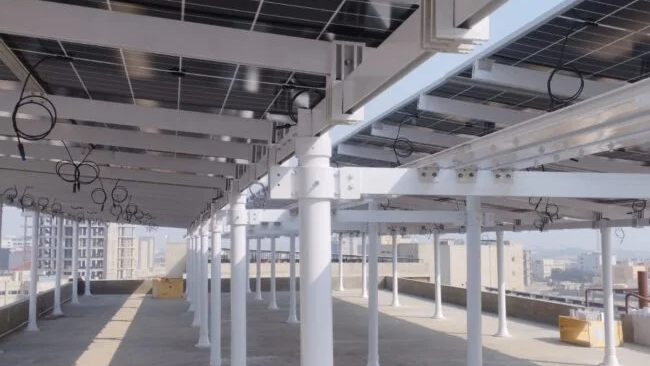
For solar structures, the correct assessment depends on the application. A rooftop support profile isn’t automatically subject to the same requirements as a primary structural member inside a building.
Why Profile Geometry Matters
Profile shape can influence heat transfer and structural behaviour.
Recent experimental work on pultruded GFRP I-beams and box-beams found measurable differences in fire resistance between the two geometries. The researchers tested 24 specimens under an ISO 834 fire curve and found that protection type, thickness, profile geometry and loading all affected performance. ScienceDirect
This shows why FRP Fire Resistance Karachi can’t be judged from the material name alone.
How Resin Selection Changes the Equation
The resin system plays an important role in FRP Flame Retardant Karachi applications.
Glass fibres can retain substantial strength at temperatures where polymer matrices have already experienced significant thermal changes. The matrix therefore becomes an important consideration when specifying an FRP profile for elevated-temperature conditions.
Manufacturers can use different resin systems and additives to modify thermal and fire behaviour. However, improving one property can affect other characteristics, including mechanical performance, processing requirements, cost, and durability.
For that reason, engineers should evaluate the complete composite rather than assuming that a product labelled “flame retardant” automatically meets every project requirement.
What Should Karachi Project Designers Check?
A proper FRP Fire Performance Karachi assessment should consider several factors before a profile enters a solar structure design.
Material Specification
The project should identify the actual resin system, reinforcement type, fibre content, profile construction, and relevant manufacturer data.
Temperature Exposure
Designers should consider expected operating temperatures as well as abnormal heat exposure.
Load During Heat Exposure
A profile that performs adequately under normal loading may behave differently when its stiffness decreases at elevated temperature.
Testing Evidence
Where fire performance matters, project teams should request relevant test data instead of relying only on general material descriptions.
Protective Measures
Where required, passive fire protection or other engineering measures should be assessed for compatibility with the FRP system.
Karachi Makes Material Specification Important
Karachi’s solar environment already exposes outdoor structures to heat, humidity, dust and coastal conditions. Fire performance represents another part of lifecycle engineering rather than a replacement for existing structural checks.
For FRP Flame Retardant Karachi projects, the correct approach is to assess the complete operating environment and the intended application.
The growing research base also shows why specifications should remain evidence-based. Recent studies continue to investigate elevated-temperature behaviour, protective coatings and structural response rather than treating FRP as a material with one universal fire rating.
Choosing the Right FRP Supplier
Technical documentation matters when specifying composite structures.
A supplier should be able to explain the profile construction, manufacturing method, resin system, mechanical properties and relevant environmental limitations.
For Karachi solar projects, PIR Electronics provides FRP solar structure solutions designed for photovoltaic applications.
The objective shouldn’t be to choose FRP simply because it is different from metal. The material should be selected because its documented characteristics match the project’s structural and environmental requirements.
The Future of FRP Solar Structures
The discussion around FRP Fire Performance Karachi reflects a wider change in composite engineering.
As FRP moves into more structural applications, designers are looking beyond strength-to-weight ratios and asking more detailed questions about thermal stability, fire behaviour, connections, manufacturing consistency and lifecycle performance.
That makes FRP Fire Resistance Karachi an important consideration for projects where elevated-temperature exposure could affect structural reliability.
At the same time, FRP Flame Retardant Karachi solutions should be specified using actual test evidence rather than marketing terminology.
For solar projects, this approach creates a more complete engineering picture: material properties, structural loading, environmental exposure, temperature behaviour and fire performance all need to work together.
FRP can offer useful advantages, but those advantages become meaningful only when the composite is properly specified for the application.
FAQs
Is FRP suitable for solar structures in Karachi?
FRP can be suitable for selected solar structural applications, but the profile, resin system, loading, temperature exposure and installation requirements should be evaluated for each project.
Does FRP automatically have high fire resistance?
No. FRP products can have significantly different fire and elevated-temperature behaviour. FRP Fire Resistance Karachi should be assessed using product-specific technical and test information.
What is the role of flame-retardant resin?
A flame-retardant resin system can modify the fire behaviour of an FRP composite, but it doesn’t automatically provide a particular structural fire rating. FRP Flame Retardant Karachi specifications should therefore include relevant test evidence.
Why is fire testing becoming more important for FRP?
Recent research continues to investigate elevated-temperature strength loss, fire resistance, protective coatings and standardisation of structural FRP products. This makes FRP Fire Performance Karachi increasingly relevant as composite structures move into more demanding applications.