
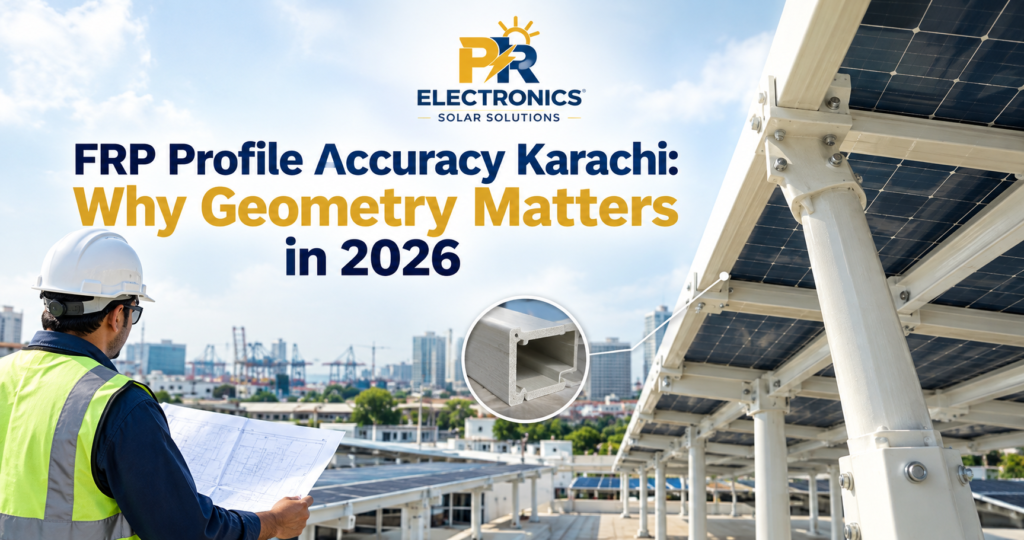
FRP structures are often discussed in terms of strength, durability and material performance. But there is another engineering factor that deserves far more attention: dimensional accuracy.
A composite profile can be manufactured from the right resin and reinforcement, yet small variations in its geometry can still influence how the finished member behaves. Wall thickness, straightness, section dimensions and local distortions all contribute to the final structural characteristics.
That makes FRP Profile Accuracy Karachi a timely topic as composite structures move into more demanding applications.
Recent 2026 research on pultruded GFRP hollow sections used high-accuracy three-dimensional coordinate measurement to investigate dimensional deviations and geometric imperfections. The researchers found that wall thickness showed meaningful variation, while some manufacturing tolerance limits were not sufficient to serve as structural acceptance criteria.
For composite manufacturers and buyers, the message is straightforward: a profile should be evaluated by more than its nominal dimensions.
Table of Contents
Why Profile Geometry Matters
Every FRP structural member has a designed cross-section.
That cross-section determines how material is distributed and how the member responds to different forms of structural action. If the manufactured profile differs significantly from its intended geometry, its actual performance can also differ from the design assumption.
This is why FRP Profile Tolerance Karachi deserves attention during specification and quality control.
Consider a hollow FRP section. Its external dimensions may appear correct while the wall thickness varies along the profile. The overall dimensions might remain within a narrow range, but local changes in thickness can influence stiffness, weight and structural behaviour.
The 2026 study found that height and width variations were relatively small, while wall thickness showed considerably greater dispersion, with a coefficient of variation reaching 8.5% in the investigated dataset.
That difference demonstrates why dimensional inspection should not focus on only one measurement.
What Does FRP Profile Accuracy Actually Mean?
FRP Profile Accuracy Karachi refers to how closely a manufactured composite profile matches its intended geometric specification.
This can include:
Cross-Section Dimensions
Engineers may specify particular width, height and wall-thickness dimensions. Consistency across production batches helps ensure that profiles behave predictably.
Straightness
A long composite member should maintain acceptable alignment. Excessive out-of-straightness can affect installation and structural behaviour.
Wall Thickness
Wall thickness is particularly important in hollow sections. Manufacturing variation can occur because of the complexity of the pultrusion process.
Twist and Warpage
A profile can satisfy basic dimensional measurements while still developing local or global geometric imperfections.
This makes FRP Section Precision Karachi a useful consideration when specifying engineered composite profiles rather than treating every FRP section as geometrically identical.
Pultrusion Is Precise, But Not Perfect
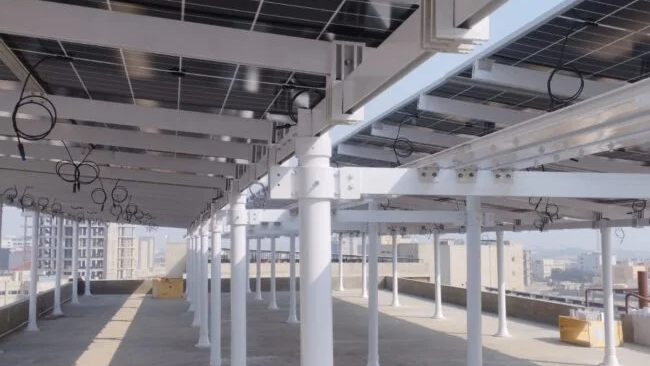
Pultrusion is an efficient continuous manufacturing process for producing composite profiles.
Reinforcing fibres are guided through the production line, impregnated with resin and pulled through a heated die where the material cures into a continuous shape.
The process provides excellent production consistency, but manufacturing is still influenced by multiple variables.
Fibre alignment, resin distribution, die condition, pulling conditions, curing behaviour and dimensional control can all influence the final profile.
Research published in 2025 investigated geometrical imperfections in pultruded GFRP open-section profiles using accurate measurement techniques. The study identified process-induced deviations such as distortions, warpage, spring-in and spring-back and highlighted the importance of understanding these variations for structural reliability.
Therefore, FRP Manufacturing Accuracy Karachi should be viewed as an ongoing quality-control objective rather than a one-time measurement.
Why Nominal Dimensions Can Be Misleading
Imagine two profiles labelled with exactly the same dimensions.
On paper, they appear identical.
In reality, one may have a more consistent wall thickness, better straightness and fewer local imperfections. The second may contain greater dimensional variation.
This difference may not be obvious during a simple visual inspection.
That is why FRP Profile Tolerance Karachi requires measurement rather than assumption.
Advanced inspection techniques can identify deviations that ordinary manual checks may miss. The 2026 research used coordinate-measuring equipment to create detailed geometric information from pultruded hollow sections and statistically analysed the resulting imperfections.
The industry is therefore moving toward a more data-driven understanding of composite profile quality.
The Importance of Cross-Section Design
Accuracy begins with good design.
The selected profile shape should match the intended structural application. Channel, box, I and other sections distribute material differently and can respond differently to deformation and instability.
Recent research published in 2026 examined several pultruded GFRP cross-sectional shapes and found meaningful differences in their behaviour under localised loading. The research covered channel, box and I-sections and demonstrated that composite profiles cannot simply be treated like conventional steel sections.
This makes FRP Section Precision Karachi particularly important when custom or specialised sections are being considered.
The geometry must first be engineered correctly. Manufacturing then needs to reproduce that geometry consistently.
Quality Control Should Go Beyond Visual Inspection
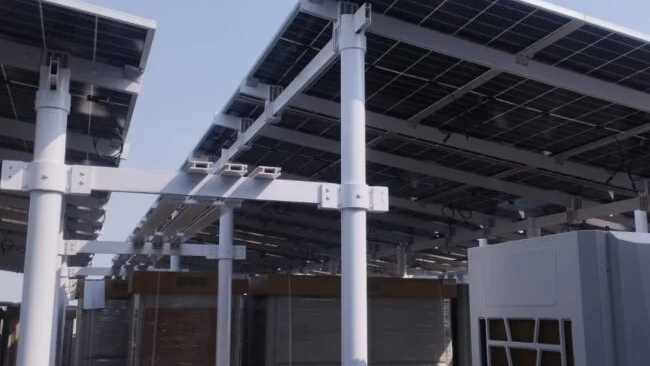
A professional FRP Manufacturing Accuracy Karachi process should involve more than checking whether a finished profile “looks straight.”
Depending on the application, quality checks can examine:
- external dimensions;
- internal dimensions;
- wall thickness;
- straightness;
- twist;
- surface condition;
- cut accuracy;
- batch consistency.
The appropriate inspection method depends on the profile and its intended use.
For high-value or technically demanding projects, dimensional records can also provide useful traceability between production batches.
This creates a stronger connection between manufacturing and structural engineering.
Why This Matters for Karachi’s FRP Market
Karachi is becoming an important market for solar and composite infrastructure. Pakistan’s solar expansion has created increasing demand for structural components that can operate reliably in outdoor environments.
As FRP adoption grows, buyers are likely to become more interested in measurable manufacturing quality rather than relying only on broad material claims.
For FRP Profile Accuracy Karachi, this means specifications should increasingly include measurable dimensional requirements.
The question should not simply be, “Is this an FRP profile?”
A better question is, “How consistently does the manufactured profile match the engineered specification?”
That shift can improve procurement decisions and reduce uncertainty.
How Better Accuracy Supports Reliable Structures
Structural engineering depends on assumptions.
When engineers model a member, they use specific dimensions and material properties. If the real product differs substantially from those assumptions, the design model may no longer represent the physical component accurately.
This does not mean every tiny variation creates a structural problem.
It means that meaningful variation should be identified, understood and controlled.
That is the real purpose of FRP Profile Accuracy Karachi.
Consistent production helps manufacturers deliver profiles whose actual geometry remains close to the design intent. It also makes engineering calculations more dependable because the physical product is more predictable.
What Buyers Should Ask FRP Suppliers
When evaluating an FRP structural supplier, buyers should ask practical questions about manufacturing quality.
What dimensional tolerances are maintained?
How is wall thickness checked?
Are production batches inspected?
How is straightness verified?
Are profile dimensions documented?
What standards or internal quality procedures guide production?
These questions help evaluate FRP Manufacturing Accuracy Karachi from an engineering perspective rather than judging a profile solely by appearance or price.
For a specialist such as PIR Electronics, discussing the required profile, application and project specifications can help establish the appropriate composite solution.
The Future of FRP Quality Is More Measurable
Composite construction is becoming more sophisticated.
Recent research is moving beyond basic material comparisons toward statistical measurement, geometric modelling and reliability assessment. The 2026 hollow-section study specifically concluded that manufacturing tolerances currently used for pultruded profiles may not always be adequate as structural acceptance criteria.
That is an important development for the FRP industry.
It suggests that future specifications may increasingly consider not only nominal dimensions but also measured imperfections and their statistical behaviour.
For FRP Section Precision Karachi, this could mean greater emphasis on digital inspection, production records and profile-specific acceptance criteria.
The result is a more mature approach to composite engineering.
Conclusion
FRP performance starts before installation.
The resin, reinforcement and profile design matter, but so does the accuracy with which the final section is manufactured.
FRP Profile Tolerance Karachi, FRP Section Precision Karachi and FRP Manufacturing Accuracy Karachi therefore deserve greater attention as composite structures become more technically demanding.
For manufacturers, better dimensional control means greater consistency. For engineers, it creates more confidence in structural calculations. For buyers, it provides a stronger basis for comparing products.
The future of FRP is not simply about producing stronger composite materials. It is about producing more predictable composite components.
FAQs
What is FRP Profile Accuracy Karachi?
FRP Profile Accuracy Karachi refers to how closely an FRP structural profile matches its specified dimensions, including width, height, wall thickness, straightness and other geometric characteristics.
Why does FRP Profile Tolerance Karachi matter?
FRP Profile Tolerance Karachi matters because dimensional variation can affect the actual geometry and structural behaviour of a composite member. Consistent manufacturing improves predictability.
How is FRP Section Precision Karachi checked?
FRP Section Precision Karachi can be evaluated through dimensional measurements, wall-thickness checks, straightness inspection and, for advanced applications, high-accuracy three-dimensional measurement.
What does FRP Manufacturing Accuracy Karachi mean for buyers?
FRP Manufacturing Accuracy Karachi gives buyers a way to assess whether profiles are produced consistently according to their specified dimensions rather than relying only on visual appearance or nominal product sizes.