
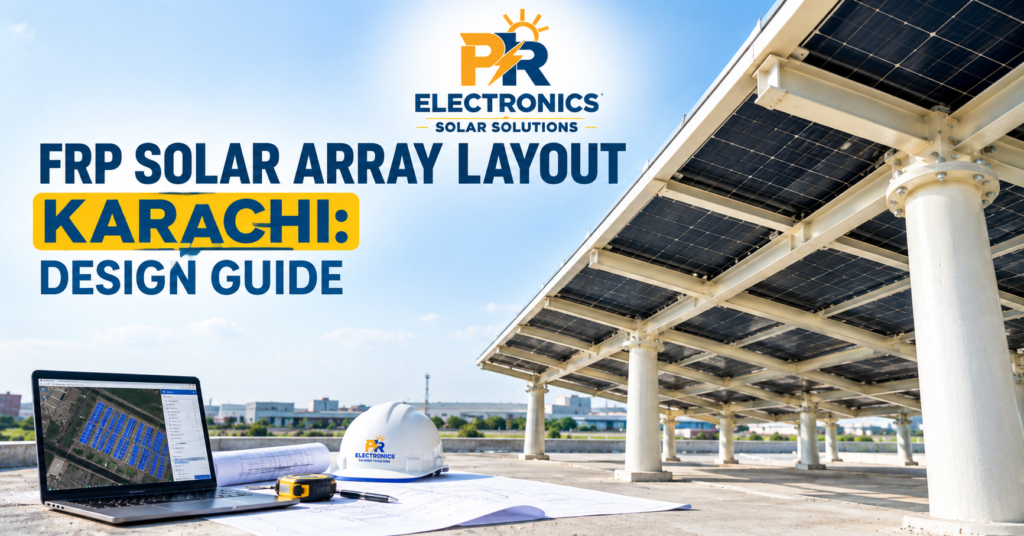
Karachi’s rooftop solar market is becoming more design-focused. As residential, commercial, and industrial buildings add larger photovoltaic systems, the challenge is no longer simply finding enough space for panels. The real challenge is arranging the complete system around rooftop obstacles, structural supports, maintenance access, and actual site conditions.
That makes FRP Solar Array Layout Karachi an important engineering consideration for projects where the mounting structure needs to work with the building rather than simply occupy available roof space.
A properly planned array can improve installation efficiency, simplify maintenance, coordinate structural members, and make better use of the available rooftop.
Table of Contents
Why Rooftop Layout Matters
A Karachi rooftop is rarely an empty rectangle. Water tanks, stair rooms, parapets, HVAC equipment, drainage points, electrical equipment, and existing service routes can all affect where solar modules can be installed.
This makes FRP Rooftop Layout Karachi more than a simple panel-placement exercise.
The design should first identify the usable roof area. After that, the module arrangement, structural members, supports, access routes, and service clearances can be coordinated.
The objective is not to cover every available square metre. It is to create a practical solar arrangement that remains accessible and structurally coordinated after installation.
Start With the Roof Geometry
One common mistake is deciding the number of modules first and trying to make the structure fit afterward.
A better approach starts with an accurate roof survey.
The design process should identify boundaries, obstacles, drainage areas, equipment zones, parapets, and required access paths. Module orientation can then be planned around those conditions.
This is where FRP Module Spacing Karachi becomes important. Spacing should not be treated as an isolated measurement. It needs to work with module dimensions, structural members, connections, installation requirements, and future maintenance.
Module Spacing Is More Than a Gap
The distance between solar modules affects the entire mounting arrangement.
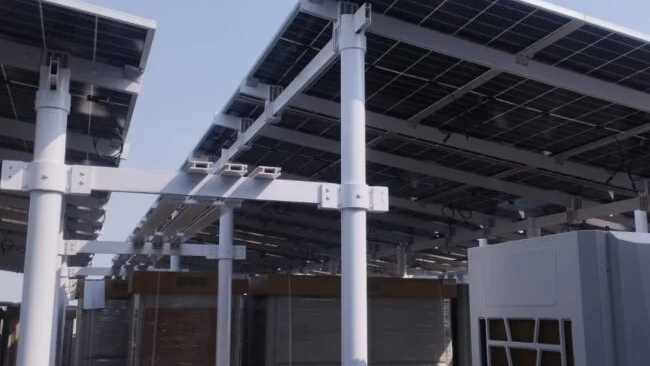
With FRP Module Spacing Karachi, designers need to consider where beams, rails, supports, and connection points will sit beneath the modules.
If panels are placed too tightly, installation and maintenance can become difficult. If they are separated unnecessarily, valuable rooftop space may be wasted.
The right approach is coordinated spacing: enough room for practical access while maintaining an efficient structural arrangement.
Position Supports Around the Load Path
Support locations should follow engineering requirements rather than simply being placed wherever there is empty roof space.
This makes FRP Support Positioning Karachi an important part of the early design process.
The designer needs to understand how loads move from the modules into the mounting members and eventually toward the building. Roof conditions, member geometry, connection points, and the planned array all influence support locations.
This becomes especially important when an existing building is being converted into a solar site because the roof was not necessarily designed specifically around the new installation.
Divide Larger Arrays Into Practical Bays
Large solar installations can become easier to design and maintain when they are divided into logical sections.
This is the role of FRP Solar Bay Design Karachi.
Instead of treating an entire rooftop as one continuous solar field, the array can be organized into module groups with coordinated structural supports and access routes.
A well-planned bay arrangement can simplify installation sequencing, inspection, cleaning, and future maintenance.
It can also make it easier to work around rooftop equipment without disturbing the entire solar installation.
Access Should Be Planned Early
Solar structures require more than initial installation. Panels and associated equipment need inspection, cleaning, troubleshooting, and occasional servicing.
For this reason, FRP Rooftop Layout Karachi should account for practical movement around the array wherever the site requires it.
This is particularly relevant for commercial and industrial rooftops. A design may accommodate a large number of modules but still create operational problems if technicians cannot safely reach important areas.
Good rooftop design balances generation capacity with accessibility.
Plan for Future Maintenance
A solar structure should remain serviceable throughout its operating life.
This means FRP Support Positioning Karachi should be considered alongside future maintenance rather than only during initial installation.
Logical support locations can help create an organized structure in which technicians can identify connection points, structural sections, and service areas more easily.
Future modifications can also become simpler when the original arrangement has been designed systematically rather than assembled around individual panel positions.
Why FRP Requires System-Level Planning
FRP should not be treated simply as a replacement for conventional structural material.
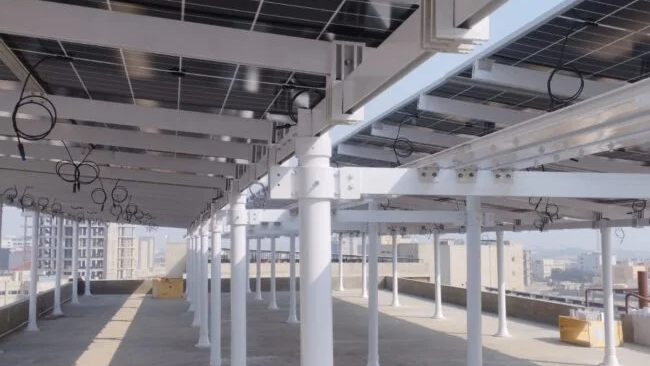
The material, connections, module arrangement, support locations, and rooftop conditions need to function as one engineered system.
For FRP Solar Array Layout Karachi, this means considering member geometry, connection positioning, load transfer, installation sequence, and the physical characteristics of the rooftop together.
The structure should be designed around the actual application rather than selecting a material first and attempting to adapt the entire layout afterward.
A Better Design Workflow
A practical workflow begins with a detailed rooftop survey.
The next stage is mapping usable areas and identifying permanent obstacles. Module orientation and grouping can then be developed using appropriate FRP Module Spacing Karachi requirements.
After that, the structural support grid can be established through FRP Support Positioning Karachi analysis. Members and connections can then be coordinated with the module groups.
The final review should consider installation access, cleaning routes, inspection requirements, and future servicing.
This approach creates a complete rooftop system instead of a panel drawing that ignores the structure beneath it.
Why Bay Planning Improves Large Rooftops
For larger installations, FRP Solar Bay Design Karachi can provide a clearer framework for organizing the structure.
Each section can be reviewed according to module arrangement, support locations, access requirements, and installation sequence.
This becomes particularly useful when a rooftop contains multiple equipment zones or irregular spaces.
Rather than forcing one uniform arrangement across the entire roof, bay-based planning allows different sections to respond to actual site conditions.
PIR Electronics and Engineered FRP Structures
For FRP solar structure solutions, PIR Electronics focuses on fiber-reinforced structures designed for solar applications.
The important consideration is not simply the material used. The complete structure needs to be coordinated with the rooftop, module arrangement, connections, supports, and service requirements.
For Karachi projects, this engineering-led approach can help turn a difficult rooftop into a more organized and maintainable solar installation.
The Next Step in Karachi Solar Structure Design
The future of rooftop solar is not only about installing more panels. It is also about using available roof space more intelligently.
FRP Solar Array Layout Karachi brings attention to an often-overlooked part of solar engineering: how the complete array is organized.
From FRP Module Spacing Karachi to FRP Support Positioning Karachi, individual design decisions affect installation, structural coordination, accessibility, and long-term serviceability.
A strong solar structure does not simply maximize the number of modules.
It creates a coordinated system that fits the roof, supports the array, provides practical access, and remains manageable throughout its service life.
FAQs
What does FRP Solar Array Layout Karachi include?
It includes module placement, structural member arrangement, support locations, rooftop obstacles, access requirements, and maintenance considerations within one coordinated design.
Why is FRP Module Spacing Karachi important?
It helps coordinate module dimensions with structural members, connection points, installation access, and future maintenance requirements.
How is FRP Support Positioning Karachi determined?
Support locations should be developed according to the structural load path, roof conditions, module arrangement, member geometry, and connection requirements.
What is FRP Solar Bay Design Karachi?
It organizes a larger solar installation into practical structural and module sections, helping coordinate supports, installation, access, and maintenance.