
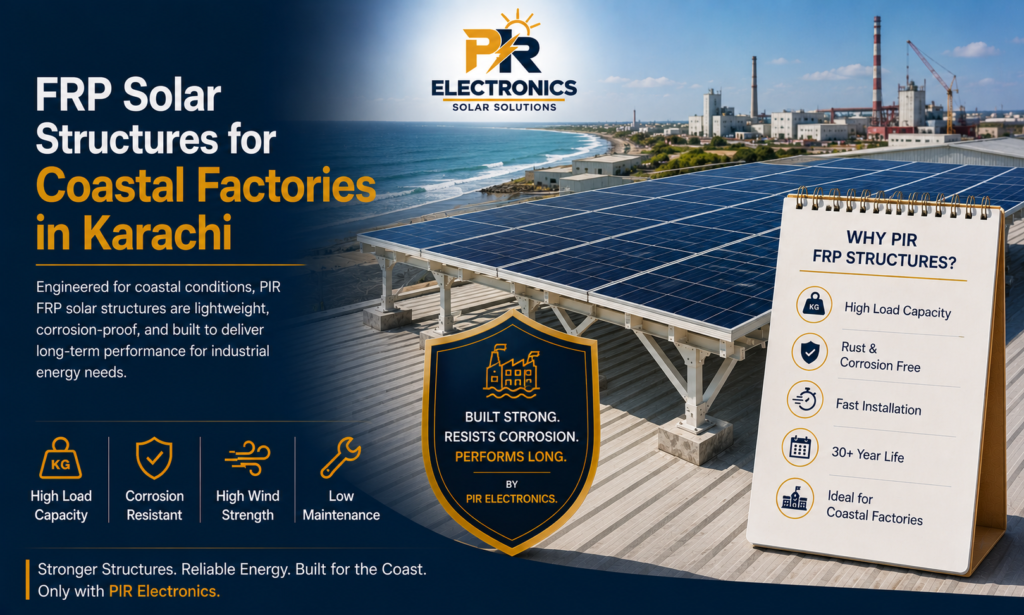
Factories near Karachi’s coastline operate in a demanding environment for rooftop equipment. Salt-bearing air, humidity, industrial fumes, ultraviolet exposure and standing water can accelerate material deterioration. Industrial buyers should therefore evaluate the mounting system as a long-term engineering asset rather than a low-cost frame beneath the panels.
Properly specified FRP solar structures Karachi can provide low weight, electrical non-conductivity and resistance to conventional rust. These qualities may benefit manufacturing plants, warehouses, food-processing units and chemical facilities where painted steel could require frequent coating repairs.
Table of Contents
Why Coastal Exposure Changes the Buying Decision
Marine-adjacent factories can expose frames, bolts, cable supports and equipment enclosures to several corrosive agents at once. Moisture acts as an electrolyte, while salt and industrial contaminants can increase corrosion severity.
The U.S. Department of Energy explains that marine-adjacent and industrial sites can accelerate corrosion in racking, fasteners, module frames and electrical equipment, potentially creating performance and safety problems.
For this reason, coastal factory solar structures should be selected after reviewing the site atmosphere, roof drainage, previous corrosion and chemicals used inside the facility. A system that performs well in a dry inland warehouse may not deliver the same service life near the coast.
What Is an FRP Solar Mounting Structure?
Fiber-reinforced polymer combines reinforcing fibres with a polymer resin. Pultruded profiles can be manufactured as channels, angles, tubes and rails, then assembled into columns, rafters, braces and panel supports.
Well-designed industrial FRP mounting systems still contain connections that require careful detailing. FRP behaves differently from steel. Stiffness, directional strength and long-term performance depend on fibre orientation, resin type, profile geometry and manufacturing quality.
Industrial buyers should request engineering calculations and material data instead of relying only on the general claim that FRP doesn’t rust.
Corrosion Resistance and Material Quality
The main commercial argument for corrosion-resistant solar structures is reduced dependence on scraping, anti-rust treatment and repainting. FRP profiles don’t undergo the same electrochemical rusting process as carbon steel.
The Federal Highway Administration describes FRP composites as lightweight, high-strength and resistant to chemicals and corrosion, while also noting that long-term performance remains an important design consideration.
Not every FRP product offers equal durability. Resin quality, ultraviolet protection, fire behaviour, chemical compatibility and fabrication practices all matter. Metal bolts, plates and clamps may still corrode when unsuitable materials are selected.
Roof Load and Installation Access
Many coastal factories use sheet roofs supported by trusses and purlins. Some buildings have also been extended or repaired several times, making their remaining load capacity uncertain.
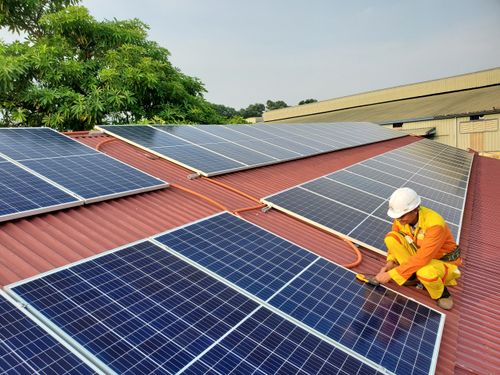
Lightweight FRP solar structures Karachi may reduce the additional dead load compared with heavier fabricated steel frames. Lower weight can also simplify lifting and rooftop handling, particularly where crane access is limited.
However, a lightweight system isn’t automatically a safe system. Wind uplift, vibration, panel weight and connection forces must still transfer safely into suitable building members.
A structural survey should examine trusses, purlins, roofing sheets, deflection, corrosion and previous modifications before installation begins.
Chemical Exposure at Factory Sites
Coastal factories may discharge vapours, fumes or dust from manufacturing processes. The selected resin should be checked against the chemicals, temperatures and concentrations expected around the rooftop.
Buyers considering industrial FRP mounting systems should provide the supplier with information about:
- Chemical exhaust outlets
- Production fumes
- Acidic or alkaline substances
- Solvents and cleaning agents
- Hot-air discharge points
- Expected rooftop temperatures
Chemical resistance should be supported by manufacturer data for the chosen resin. A general statement about FRP shouldn’t replace a site-specific compatibility review.
Wind Loading and Structural Height
Industrial roofs are often large and unobstructed. Panels installed near corners, parapets and roof edges may experience different wind pressures from modules placed in central areas.
The U.S. Department of Energy states that photovoltaic arrays need stable, durable mounting capable of supporting the panels and resisting wind, rain and corrosion over decades.
Proper coastal factory solar structures require calculated member sizes, support spacing, diagonal bracing, clamps and anchors. Elevated frames that create storage or working space beneath the panels generally experience greater wind forces than low-height arrays.
Removing braces to save material or increasing the frame height after design approval can change the complete structural load path. Any modification should be reviewed by the original designer or another competent engineer.
FRP Compared With Steel and Aluminium
Galvanised steel offers high stiffness, familiar fabrication and broad availability. It can perform effectively when coating quality, drainage and maintenance are properly managed. Its disadvantages can include greater weight and corrosion where the protective layer is damaged.
Aluminium is relatively lightweight and naturally develops a protective oxide layer. It’s commonly used for modular rails and clamps, although alloy grade, profile thickness and contact with dissimilar metals require attention.
FRP can be attractive where low weight, electrical insulation and resistance to rust are priorities. Still, corrosion-resistant solar structures should be compared as complete systems rather than by the main profile material alone.
Connections, anchors, clamps, fasteners and interface plates may become the weakest points in an otherwise durable structure.
Roof Survey and Layout Planning
A survey for factory rooftop solar Karachi should document the roof type, purlin spacing, truss condition, skylights, vents, chimneys, drains and access routes. It should also identify areas affected by hot exhaust or chemical discharge.
The layout must preserve safe access for:
- Roof repairs
- Firefighting activities
- Panel cleaning
- Drain inspection
- Ventilation-equipment servicing
- Water-tank maintenance
- Emergency movement
Panel rows shouldn’t block drainage channels or prevent access to factory equipment.
On sheet roofs, structural loads should transfer into suitable purlins or primary members rather than relying only on thin cladding. Roof penetrations require compatible flashing and sealing, while ballasted systems need verified roof capacity.
What Industrial Buyers Should Request
A technical quotation should provide more than a general price per kilowatt. It should identify:
- FRP resin and fibre type
- Profile dimensions and wall thickness
- Structural loads and design assumptions
- Support and bracing distances
- Anchor and base-plate details
- Fastener and clamp materials
- Ultraviolet-resistance information
- Chemical-compatibility data
- Fire-performance information
- Installation and material warranties
- Inspection requirements
Companies evaluating industrial solar structure solutions should also request layout drawings, structural calculations and a complete bill of materials explaining how the design suits the coastal factory environment.
Lifecycle Cost Instead of Initial Price
The lowest purchase price doesn’t always produce the lowest ownership cost. Industrial buyers should consider repainting, shutdown access, replacement of corroded parts, inspection labour and possible roof repairs.
Although industrial FRP mounting systems may carry a higher initial material cost in some projects, reduced surface-maintenance requirements can improve lifecycle value.
A fair comparison should use technically equivalent steel, aluminium and FRP designs. Comparing a fully braced FRP frame with an undersized steel quotation won’t provide a realistic cost assessment.
Inspection and Maintenance
FRP doesn’t require routine anti-rust painting, but it still needs inspection. Maintenance teams should look for impact damage, cracks, exposed fibres, loose connections, movement and damage caused by later rooftop work.
Metal parts used in corrosion-resistant solar structures deserve particular attention. Blocked drains, debris around mounting bases and standing water should also be corrected before they affect roof surfaces or connection points.
After strong winds or major factory maintenance, the array should be checked for panel misalignment, vibration, damaged cables and altered bracing.
Final Thoughts
Selecting factory rooftop solar Karachi mounting isn’t simply a choice between FRP, steel and aluminium. Industrial buyers must consider corrosion, structural weight, chemical exposure, wind, fire performance and roof condition together.
Properly engineered FRP solar structures Karachi projects can provide valuable advantages in coastal and industrial environments, particularly where rust control and roof loading are major concerns.
A successful factory rooftop solar Karachi project begins with verified material data, structural calculations and a complete site assessment—not a generic frame selected only by price.
FAQs
Are FRP structures suitable for every coastal factory?
No. Suitability depends on roof capacity, wind exposure, chemical conditions, fire requirements, frame height and connection details.
Is FRP stronger than steel?
The materials behave differently. Steel generally has greater stiffness, while FRP can offer a high strength-to-weight ratio. Specific profiles, spans and connections must be compared.
Can FRP support elevated solar canopies?
Yes, when engineered for the span, height, wind forces and activities beneath the array. Elevated coastal factory solar structures generally require larger members, stronger anchors and additional bracing.
Does FRP require maintenance?
Yes. Profiles, anchors, joints, bolts, clamps and roof interfaces still require periodic inspection.