
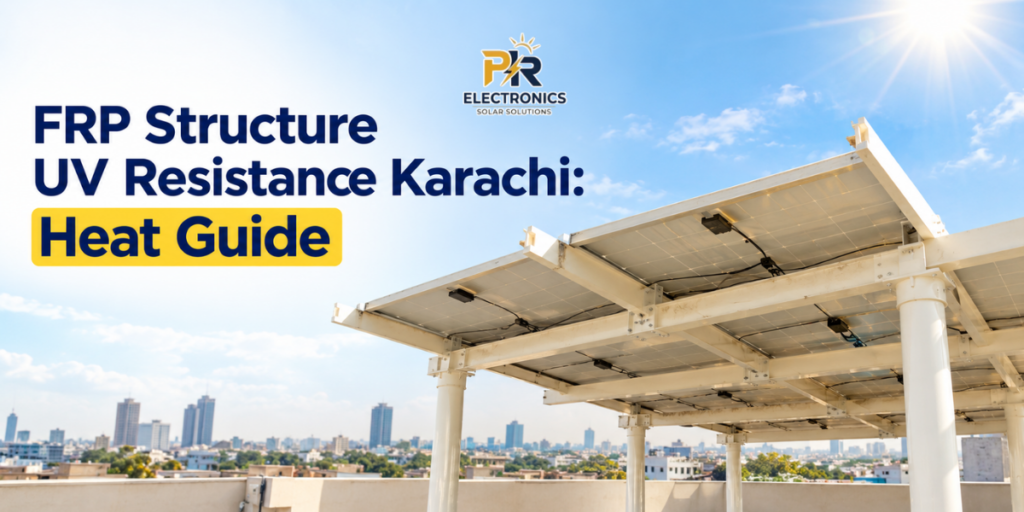
Karachi’s solar market is moving beyond the early phase of simply installing panels and inverters. As rooftop photovoltaic systems become long-term infrastructure, attention is shifting toward the materials supporting those systems and how they behave under continuous environmental exposure.
That makes FRP Structure UV Resistance Karachi an increasingly relevant engineering question.
A solar mounting structure in Karachi may experience intense ultraviolet radiation, elevated surface temperatures, humidity, airborne salts, dust, and repeated thermal cycling. These conditions do not automatically make FRP unsuitable. They do, however, make material specification and long-term performance much more important.
Research on GFRP pultruded profiles has shown that exposure to UV radiation, moisture and elevated temperature can influence mechanical properties over time. One study tested profiles for up to 3,000 hours and reported reductions in flexural, tensile and compressive properties under the tested ageing conditions.
For solar projects in Karachi, that evidence supports a more technical approach to composite structure selection.
Table of Contents
Why UV Exposure Matters in Karachi
The first issue in FRP Structure UV Resistance Karachi is the polymer matrix.
FRP consists of reinforcing fibres embedded within a polymer resin. The fibres provide much of the structural strength, while the resin binds the composite together and protects the reinforcement.
Long-term ultraviolet exposure can affect the outer surface of the polymer matrix. Depending on the resin system, additives, surface protection and exposure conditions, ageing may involve changes in colour, surface finish and eventually mechanical performance.
The important point is that “UV resistant” should not be treated as a universal property of every FRP product.
Different formulations behave differently.
For FRP Solar Structure Performance, buyers should therefore ask for product-specific technical information rather than relying on the general assumption that all FRP composites have identical outdoor durability.
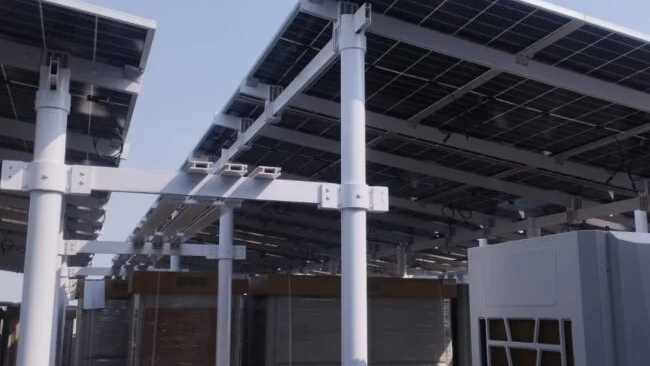
Heat and UV Do Not Act Separately
Karachi’s climate creates another issue: environmental factors can interact.
A solar structure is exposed to sunlight while the photovoltaic modules above it can become significantly hotter than ambient air. The structure then experiences repeated heating and cooling as conditions change during the day and across seasons.
For FRP Solar Structure Durability, this matters because elevated temperature can influence the behaviour of the polymer matrix, particularly when temperatures approach material-specific limits.
Research reviewing FRP behaviour at elevated temperatures notes that performance can become more problematic as temperatures approach or exceed the glass-transition temperature of the resin system.
This is why an engineering assessment should consider actual operating temperatures rather than using Karachi’s average air temperature as the only reference.
PIR Electronics publishes a 60–70°C stability-temperature range for its FRP solar structure products. That is a manufacturer-specific specification, not a universal limit for all FRP systems.
Why the Resin System Matters
A serious FRP Structure UV Resistance Karachi assessment cannot focus only on the word “FRP.”
The actual performance depends on the fibre type, resin chemistry, fibre orientation, profile geometry, manufacturing process and protective surface system.
Pultruded GFRP profiles, for example, can be produced with different cross-sections and material formulations. Research has found that cross-section characteristics can also influence the degree of degradation under combined UV and moisture exposure.
That means two products labelled FRP may not have the same long-term behaviour.
For FRP Solar Structure Performance, technical documentation should ideally identify the product construction, environmental limitations and relevant testing information.
This is particularly important when a structure is expected to support a solar array for decades.
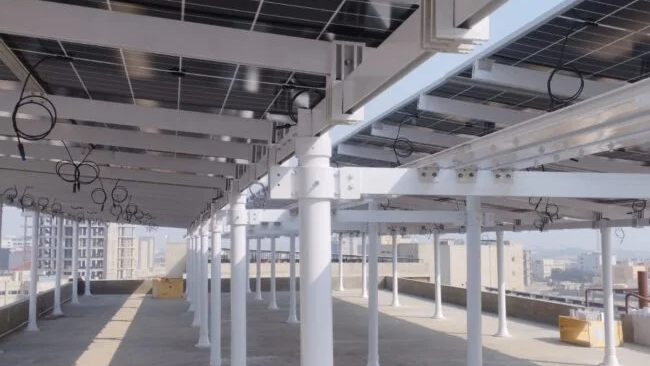
Durability Is More Than Corrosion Resistance
Corrosion resistance is one of the strongest reasons to consider FRP for coastal environments, but FRP Solar Structure Durability should be assessed more broadly.
A structure can resist rust while still experiencing other forms of ageing.
UV exposure, temperature cycling, moisture ingress, sustained loading, mechanical connections and impact can all influence long-term behaviour.
Recent research on pultruded GFRP profiles has specifically identified ultraviolet radiation, moisture, thermal effects and sustained loading as interacting durability mechanisms rather than isolated concerns.
That makes lifecycle thinking more useful than simply comparing the purchase price of FRP and metal.
Karachi’s Solar Market Makes This More Relevant
Pakistan’s solar market has expanded rapidly in recent years, increasing the importance of long-term system design.
The federal government currently allows distributed-generation and net-metering systems from 1 kW up to 1 MW under the applicable framework, while NEPRA continues to publish annual State of Industry reporting on the power sector.
As more rooftop installations become permanent assets, structural material selection becomes a lifecycle decision.
That is where FRP Solar Structure Performance becomes commercially important.
The mounting structure is expected to remain stable while the panels, wiring and electrical equipment operate through years of outdoor exposure.
How to Evaluate FRP Mounting in Karachi
A practical FRP Structure UV Resistance Karachi review should begin with the complete installation rather than the material name.
The project team should establish the expected environmental exposure, roof conditions, wind loads, panel arrangement and structural configuration.
Next comes the product specification.
The buyer should ask:
- What resin system is being used?
- What UV protection is incorporated?
- What temperature range applies to the actual profile?
- What testing supports the environmental claims?
- How are the connections designed?
- What fasteners and brackets are being used?
These questions help establish whether the proposed FRP Solar Mounting Karachi solution is genuinely appropriate for the site.
Connections Still Control System Performance
One of the most overlooked aspects of composite solar structures is the connection.
Even when the main FRP profile has suitable mechanical properties, the complete structure also depends on bolts, brackets, clamps, anchors and interfaces with the roof.
For FRP Solar Structure Performance, these connections must transfer loads properly and remain suitable for the environment.
This is especially important for wind.
Solar arrays create significant exposed surface area, so the mounting system must account for site-specific wind loading, panel dimensions, support spacing and anchoring.
The IEC PV-array design requirements provide an established framework for addressing mechanical and mounting considerations in photovoltaic array design.
What Buyers Should Look for in Karachi
The strongest FRP Structure UV Resistance Karachi solution is not necessarily the one with the most attractive marketing claim.
It is the one supported by appropriate material selection, structural calculations, environmental specifications and installation detailing.
Buyers evaluating FRP Solar Mounting Karachi should compare the complete system rather than only the primary profile.
They should also consider whether the supplier can conduct a site assessment and adapt the design to the roof instead of supplying an identical frame for every application.
For projects where UV exposure, heat and corrosion are central concerns, this distinction can have major implications over the service life of the installation.
A More Evidence-Based Approach to FRP
The case for FRP should be based on engineering characteristics rather than simple promotional comparisons.
An FRP Structure UV Resistance Karachi assessment should recognise both the benefits and the limitations of composite materials.
FRP can offer low weight, electrical non-conductivity and strong resistance to corrosion. At the same time, long-term performance depends on the resin, reinforcement, geometry, environmental exposure and connections.
PIR Electronics focuses on FRP-based solar structural systems and provides site-based assessment and installation support for solar applications.
For a Karachi project, PIR Electronics can evaluate the application and develop the mounting solution around the required site conditions.
The Real Measure of Long-Term Value
A technically sound FRP Solar Structure Durability strategy begins before installation.
UV exposure should be considered.
- Temperature should be considered.
- Moisture should be considered.
- Wind loading should be considered.
- Connections should be considered.
- Maintenance should be considered.
When those variables are assessed together, FRP Solar Structure Performance becomes something that can be evaluated rather than assumed.
The growing solar market in Pakistan makes this increasingly important. The more solar capacity moves onto rooftops, the more valuable it becomes to understand the infrastructure underneath the modules.
For FRP Solar Mounting Karachi, the objective should therefore be simple: select a system whose material characteristics, environmental resistance and structural design are appropriate for the actual location.
Karachi does not provide a mild outdoor environment for decades-long infrastructure.
It demands materials and designs that are selected with the local environment in mind.
FAQs
What does FRP Structure UV Resistance Karachi mean?
It refers to how an FRP structure intended for Karachi performs when exposed to prolonged ultraviolet radiation and related outdoor environmental conditions. Performance depends on the resin, reinforcement, surface protection and profile design.
Does sunlight reduce FRP durability?
Long-term UV exposure can affect the polymer matrix of FRP composites. Research has documented changes in mechanical properties under combined UV, moisture and temperature conditioning, although the extent depends on the material and profile.
How does heat affect FRP solar structures?
Elevated temperature can influence FRP mechanical behaviour, particularly as temperatures approach the resin’s glass-transition range. The applicable temperature limits must therefore be determined from the specific product specification.
Is FRP a good choice for solar mounting in Karachi?
It can be an effective option where corrosion resistance, low weight and electrical non-conductivity are valuable. However, FRP Solar Structure Durability should be evaluated using the specific product, connections, environmental exposure and site loading rather than the FRP label alone.