
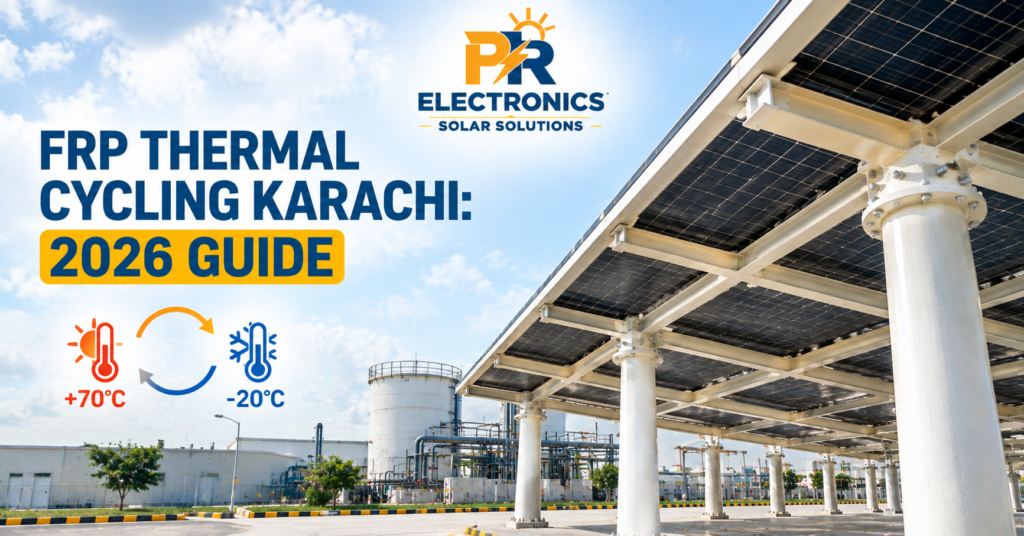
Karachi’s rapid expansion of distributed solar is changing the engineering requirements for mounting infrastructure. Renewables First estimates that Pakistan’s distributed solar capacity reached about 38 GW in FY25, with distributed generation equivalent to around 46% of grid electricity. This scale makes structural durability increasingly important, particularly in Karachi, where solar equipment operates through intense heat, humidity, coastal exposure and repeated daily temperature changes.
For engineers and project developers, the question is no longer simply whether a mounting material can carry a panel. The more important question is how the structure behaves after thousands of heating and cooling cycles.
This is where FRP Thermal Cycling Karachi becomes an important engineering consideration. Fibre-reinforced polymer composites can provide a combination of low weight, corrosion resistance and electrical non-conductivity, but their long-term performance depends on resin selection, reinforcement architecture, connection design, temperature exposure and installation quality.
Table of Contents
Why Thermal Cycling Matters in Karachi
A solar mounting structure experiences continuous temperature variation. During the day, solar radiation heats modules and the supporting structure. After sunset, temperatures fall. This creates repeated expansion and contraction within structural components and their connections.
Karachi adds another layer of environmental stress because of its coastal location. The Pakistan Meteorological Department describes Karachi as a coastal, arid city with long hot summers and relatively high humidity associated with its proximity to the Arabian Sea.
Therefore, FRP Solar Structure Heat Cycling deserves attention during structural selection rather than being treated as a secondary material property.
Thermal cycling can affect a structure through:
- repeated dimensional movement;
- changes in stiffness with temperature;
- stress concentration around fasteners;
- differential movement between materials;
- resin ageing under combined environmental exposure;
- gradual changes at joints and interfaces.
The important point is that thermal cycling rarely acts alone. Heat, ultraviolet radiation, moisture and mechanical loading can interact over the operating life of a solar installation.
The Engineering Behind FRP Thermal Cycling
FRP is not a single material with one universal thermal response. Its behaviour depends on the polymer matrix, fibre type, fibre orientation, fibre volume and manufacturing process.
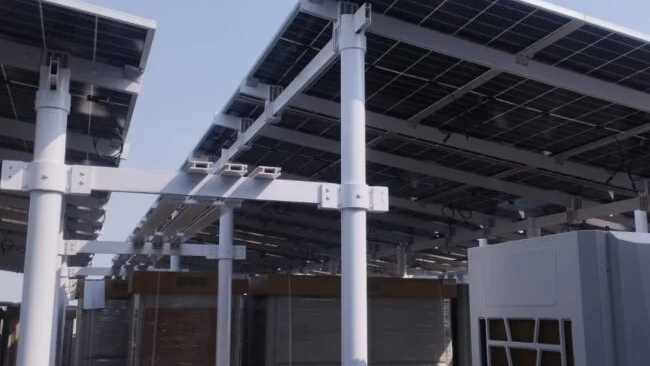
In pultruded profiles, continuous reinforcement carries structural loads while the polymer matrix binds and protects the reinforcement. The resulting composite can have significantly different thermal expansion behaviour from conventional metals.
This makes FRP Composite Thermal Cycling a useful design consideration for solar structures exposed to repeated environmental changes.
The coefficient of thermal expansion can vary according to fibre direction. A pultruded profile therefore does not necessarily expand equally in every direction. Engineers must consider longitudinal and transverse behaviour when designing connections, spans and restrained members.
This becomes particularly important when FRP components connect with metals. Aluminium and steel have different thermal expansion characteristics. If a connection prevents natural movement, repeated temperature changes can introduce additional stresses.
Consequently, FRP Mounting Thermal Stability depends not only on the FRP profile itself but also on how the complete mounting assembly accommodates movement.
Heat Cycling and Connection Design
One of the most overlooked aspects of FRP Solar Structure Heat Cycling is connection behaviour.
A profile may have excellent structural properties, but the overall assembly can still develop problems if bolts, brackets, washers and interfaces are poorly designed.
Engineers should consider:
Controlled Thermal Movement
Connections should accommodate the expected dimensional movement instead of unnecessarily restraining every member.
Load Distribution
Fasteners should distribute loads over an adequate area. Excessive local pressure can create stress concentrations in composite profiles.
Material Compatibility
Where FRP connects with aluminium or steel, engineers should consider differences in thermal expansion and environmental behaviour.
Long-Term Exposure
The connection should remain mechanically reliable after prolonged exposure to heat, moisture and ultraviolet radiation.
These considerations directly influence FRP Mounting Thermal Stability, especially on large rooftop systems where hundreds or thousands of connections may experience the same daily thermal cycle.
Why FRP Can Be Relevant to Karachi Solar Projects
Traditional metallic mounting systems remain widely used, but coastal environments create a persistent corrosion-management challenge. FRP can offer a different engineering approach because the composite itself does not behave like conventional steel when exposed to moisture and salt-laden environments.
For Karachi projects, this matters because mounting structures can remain exposed for many years while being difficult and expensive to replace.
The IEA PVPS notes that photovoltaic systems deployed in harsh climates face environment-specific reliability risks and that climate-specific design and mitigation strategies are increasingly important.
That broader principle supports a site-specific approach to FRP Thermal Cycling Karachi rather than selecting mounting materials purely from generic catalogue specifications.
IEA PVPS climate-specific PV reliability research
UV Exposure and Thermal Cycling Work Together
Heat is only one part of the ageing mechanism.
Continuous ultraviolet exposure can gradually affect polymeric materials depending on the resin system, protective surface treatment and formulation. When UV exposure occurs together with repeated heating and cooling, the material experiences a more complex environmental ageing process.
IEA PVPS research on photovoltaic reliability identifies UV-induced degradation and combined UV, humidity and temperature stresses as important areas of investigation for long-term PV performance.
This makes FRP Composite Thermal Cycling particularly relevant when evaluating the expected service environment rather than relying only on initial mechanical test values.
A responsible specification should therefore examine:
- resin chemistry;
- UV stabilisation;
- operating temperature;
- moisture exposure;
- fibre orientation;
- profile geometry;
- connection configuration;
- expected structural loads.
FRP Structural Heat Resistance Is a System Property
It is tempting to evaluate FRP Structural Heat Resistance using a single maximum temperature number. That approach can be misleading.
The temperature capability of an FRP component depends on the polymer matrix and its glass-transition behaviour, along with the mechanical loads applied during operation.
A profile that performs adequately at a particular temperature under one loading condition may behave differently under sustained loading or repeated temperature cycles.
For this reason, FRP Structural Heat Resistance should be considered alongside mechanical loading, creep behaviour, environmental ageing and connection design.
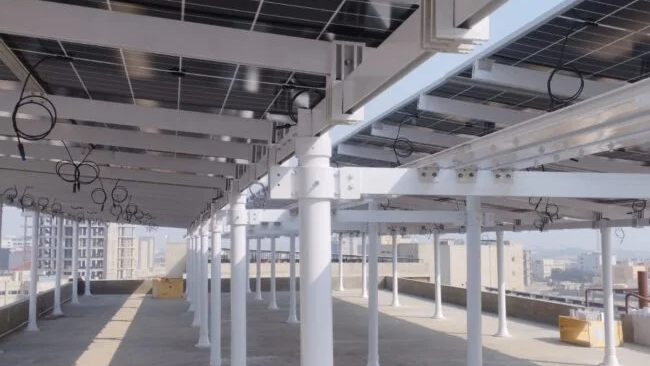
This is especially relevant to rooftop solar where modules, mounting rails and support members remain exposed to direct solar radiation for years.
Designing for Karachi’s Coastal Solar Environment
The latest solar market data reinforces why this issue matters. Pakistan’s distributed solar fleet has expanded rapidly, while solar generation has become a significant component of the country’s electricity system.
As installations become larger and more commercially important, structural selection needs to move beyond initial installation cost.
A properly engineered FRP Solar Mounting Durability assessment should consider the complete lifecycle.
For Karachi installations, the assessment can include:
- Expected temperature range and daily thermal cycling.
- UV exposure and resin protection.
- Humidity and coastal environmental exposure.
- Wind loading and structural deflection.
- Fastener and joint behaviour.
- Compatibility between FRP and metallic components.
- Long-term creep and mechanical retention.
- Inspection and maintenance requirements.
This approach makes FRP Solar Mounting Durability a lifecycle engineering issue rather than simply a material-selection issue.
What Engineers Should Check Before Selecting FRP
Before specifying an FRP solar mounting system, project teams should request technical documentation covering the actual profile and application.
Important information includes tensile and flexural properties, temperature limits, resin system, fibre reinforcement, dimensional tolerances, UV protection, connection recommendations and applicable testing.
Engineers should also distinguish between laboratory performance and expected field performance. The IEA PVPS highlights the importance of understanding real environmental stressors and reliability mechanisms when designing PV systems for different climates.
For this reason, FRP Thermal Cycling Karachi should be assessed using the expected site conditions rather than a generic statement that the material is “heat resistant.”
Why Lifecycle Engineering Matters More Than Initial Cost
The increasing size of Pakistan’s solar fleet means mounting structures are becoming long-term infrastructure assets rather than temporary installation components.
A low-cost structure can become expensive if it requires frequent intervention, premature replacement or extensive corrosion management.
Conversely, a correctly engineered FRP system can potentially reduce some of the environmental problems associated with conventional metallic structures. However, its suitability still depends on engineering design, manufacturing quality and correct installation.
The objective should therefore be FRP Solar Mounting Durability over the expected service period, not simply the lowest initial procurement price.
Choosing an FRP Partner for Solar Infrastructure
For Karachi solar projects, the supplier should understand that composite mounting is an engineering system rather than simply a collection of profiles.
PIR Electronics provides FRP-based solar structure solutions designed around the requirements of solar installations, including the advantages associated with lightweight, non-conductive and corrosion-resistant composite construction.
A technically sound specification should connect material properties with site conditions, loading requirements, thermal movement and installation details.
That approach is particularly important when evaluating FRP Structural Heat Resistance, because long-term structural performance depends on the interaction between material, environment and design.
The Future of FRP Solar Structures in Karachi
Pakistan’s solar transition is continuing at a scale that is changing how businesses evaluate energy infrastructure. Renewables First reports that distributed solar reached approximately 38 GW by FY25, highlighting the growing importance of privately deployed solar generation.
As this installed base expands, structural reliability will receive greater attention.
The future of FRP Composite Thermal Cycling research will likely involve better accelerated ageing methods, improved resin systems, more detailed environmental testing and stronger lifecycle modelling.
For Karachi, the engineering objective should remain clear: select materials and structures that are designed for the actual combination of heat, UV, humidity, coastal exposure and mechanical loading.
When these factors are considered together, FRP Solar Mounting Durability becomes a measurable engineering objective rather than a marketing claim.
FAQs
1. Why is FRP Thermal Cycling Karachi important for solar structures?
FRP Thermal Cycling Karachi matters because solar structures experience repeated heating and cooling, while Karachi adds coastal humidity, UV exposure and high-temperature conditions. These combined stresses should be considered during structural design.
2. Does FRP provide good thermal stability for solar mounting?
FRP Mounting Thermal Stability depends on the resin system, reinforcement, profile design, operating temperature and connection details. Engineers should evaluate the complete system rather than relying on one material specification.
3. How does heat affect FRP solar mounting durability?
Heat can influence stiffness, dimensional movement and long-term material behaviour. FRP Solar Mounting Durability therefore requires consideration of temperature, loading, UV exposure, moisture and connection design together.
4. What should Karachi projects check before selecting FRP?
Projects should evaluate FRP Structural Heat Resistance, UV protection, thermal movement, mechanical loading, connection design, environmental exposure and manufacturer testing before final selection.