
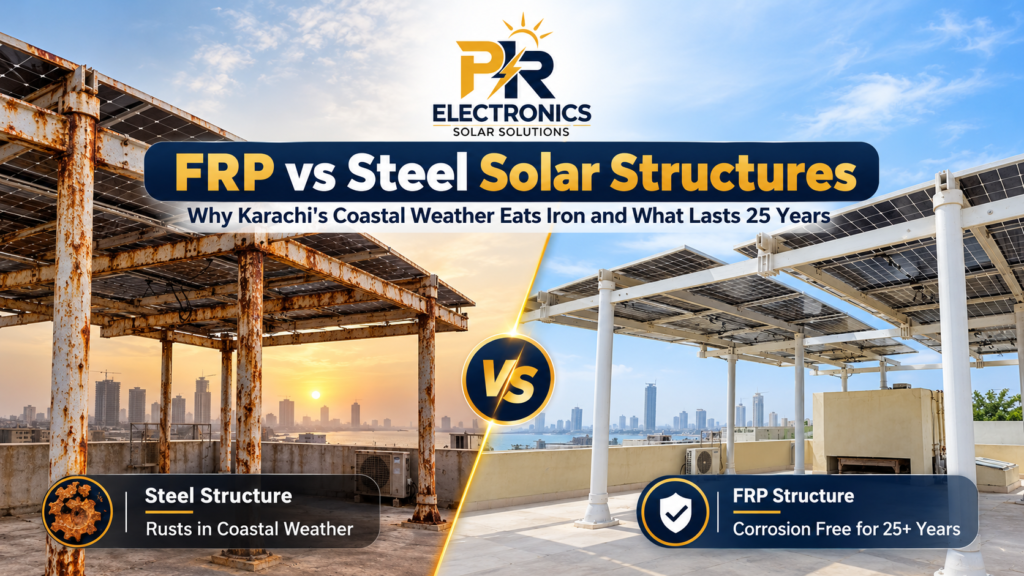
Your solar panels are engineered to live 25–30 years. That’s printed on the datasheet. But what about the structure holding them? In Karachi, a steel mounting structure often doesn’t see its tenth birthday. The panels outlive their own frame and that’s a problem the industry doesn’t talk about enough. This guide compares FRP vs steel solar structures for Karachi’s coastal climate.
Why Karachi Is Especially Hard on Steel
Steel is strong. Nobody disputes that. The issue is chemistry, not strength. Karachi combines three things that corrode iron:
- Coastal humidity: Sea breeze from Clifton to Korangi keeps the air moist year-round. Moisture is the first ingredient of rust.
- Salinity: Airborne salt accelerates corrosion far faster than plain water.
- Pollution: Industrial emissions in areas like SITE and Landhi create acidic deposits on metal surfaces.
Even galvanized steel coated to resist rust eventually loses its coating at joints, bolt holes, and scratches from installation. Once that happens, rust starts from the inside of the joint, where you can’t see it.
What Rust Actually Costs You
A rusting structure doesn’t fail dramatically overnight. It fails slowly, and expensively:
- Weakened joints: Rust thins the metal where it matters most the connections. A weakened joint plus a Karachi windstorm is a genuine structural risk.
- Repainting cycle: Rusting steel structures need repainting and treatment every 2–3 years. Over 25 years, that’s 8–10 maintenance rounds.
- Premature replacement: Many steel structures need full replacement after 10–15 years while the panels on top still have a decade of life left. You’re paying for the structure twice.
- Rooftop damage: Rust stains and corroded anchors can damage the roof slab itself.
FRP vs Steel Solar Structures: The Rust-Proof Alternative
FRP fiber-reinforced polymer, commonly called fiberglass is an engineered composite material. Here’s how it compares:
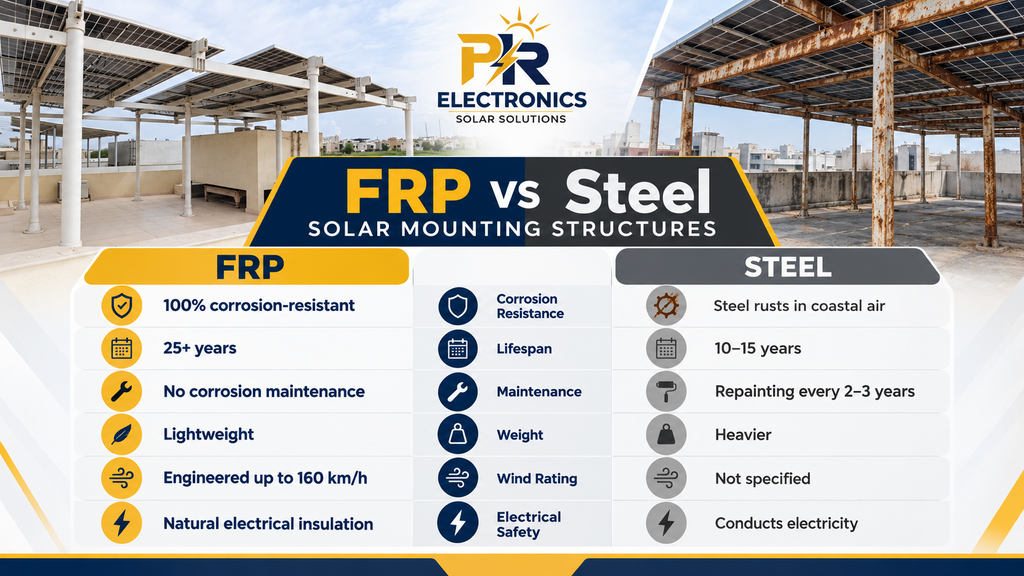
| Factor | Steel | FRP (Fiberglass) |
|---|---|---|
| Corrosion resistance | Rusts in coastal air | 100% corrosion-resistant no rust, ever |
| Lifespan | 10–15 years typical in Karachi | 25+ years, matches panel life |
| Maintenance | Repainting every 2–3 years | None for corrosion |
| Weight | Heavy, adds rooftop load | Lightweight, less roof stress |
| Wind resistance | Strong but weakens as it rusts | Engineered for wind loads up to 160 km/h |
| Electrical safety | Conducts electricity | Natural electrical + thermal insulation |
The headline number: a 25+ year lifespan that matches your panels’ 25–30 year life. One structure, one installation, for the life of the system.
The Math Installers Should Do
A steel structure looks cheaper on day one.
When you compare FRP vs steel solar structures over 25 years, the cheaper day-one option is rarely the cheaper lifetime option.
A steel structure looks cheaper on day one. But compare it over the real 25-year life of the system:
- Steel: lower initial cost + 8–10 repainting cycles + one full replacement around year 12 = roughly double the structure cost over 25 years, plus the headache.
- FRP: higher initial investment, zero corrosion maintenance, no replacement.
For EPC contractors, there’s another angle: a structure that never needs repainting is a structure your customers never complain about. Fewer warranty headaches, better referrals.
“But Is It Strong Enough?”
This is the most common question when comparing FRP vs steel solar structures, and the fair on.PIR Electronics designs mounting structures specifically for Karachi’s wind zones, rated up to 160 km/h. Fiberglass composite is used in marine, aviation, and chemical industries precisely because it combines strength with corrosion resistance. It’s not a compromise on strength it’s an upgrade on durability.
Plus the lighter weight means less load on your roof slab, and the electrical insulation adds a safety margin that conductive steel frames simply can’t offer.
What to Check Before You Buy
Whether you choose FRP vs steel solar structures, the structure is only as good as its engineering.
- Is it site-engineered? A structure designed for Karachi’s wind zones is very different from a one-size-fits-all frame.
- What is the wind rating? Karachi experiences strong gusts, especially during monsoon season. Look for a rating up to 160 km/h.
- How are the joints protected? Joints and bolt points are where corrosion and fatigue start. FRP eliminates the corrosion question entirely.
- Does the lifespan match the panels? If your panels are warrantied for 25 years, your structure should be designed for the same horizon not half of it.
The Installer Angle: Fewer Callbacks
For solar installers and EPC contractors, the structure choice affects your reputation for decades. A rusting steel frame generates the calls nobody wants: repainting requests, joint repairs, and eventually full replacements under the shadow of a warranty dispute. An FRP structure, installed once, quietly does its job for the life of the panels. Fewer callbacks, better referrals, and a story you can tell with confidence: “Your panels live 25–30 years and so does the structure holding them.”
The Bottom Line
Your panels live 25–30 years — what about the structure holding them?
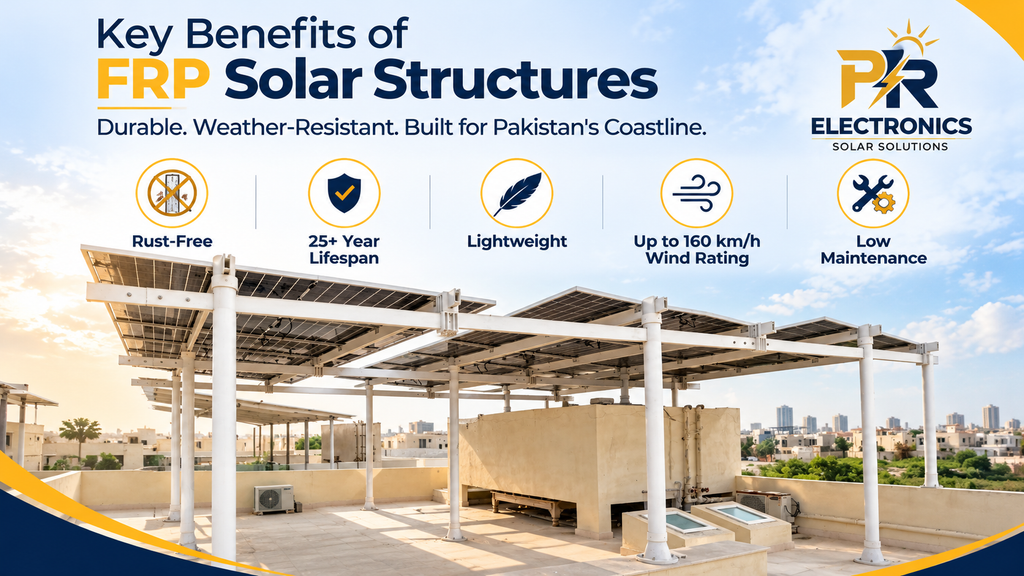
In Karachi’s coastal climate, steel rusts, needs repainting, and often gets replaced before the panels die. FRP fiberglass structures are rust-proof, lightweight, wind-rated to 160 km/h, and engineered to last as long as the panels they hold.
Comparing FRP vs steel solar structures for a new system or a replacement? Call PIR Electronics at 0308-1889998 or visit pirelectronics.com.