Installing high-quality solar panels is only one part of building a reliable rooftop solar system. The FRP solar structure Karachi supporting those panels is equally important because it controls their stability, alignment, height, tilt and resistance to environmental pressure.
For homeowners and businesses searching for a dependable solar structure DHA Karachi, local coastal conditions must be considered carefully. DHA is close to the Arabian Sea, exposing rooftops to humidity, airborne salt, intense heat, dust, rain and occasional strong winds. An unsuitable structure may corrode, loosen, shift or place unnecessary weight on the roof.
Fiber-reinforced polymer, commonly called FRP, offers an alternative to conventional metal structures. A properly designed fiber solar structure Karachi installation can provide corrosion resistance, reduced rooftop weight and long-term structural support. However, good materials must still be combined with proper engineering, anchoring and installation.
Table of Contents
Why Solar Structures Matter More in 2026
Pakistan’s rooftop solar market has expanded rapidly. According to the Pakistan Economic Survey 2025–26, Pakistan’s total installed electricity-generation capacity reached 49,651 MW by March 2026. Renewable capacity stood at 10,101 MW, representing 20.3% of the total, and included 7,319 MW from net-metering installations.
In comparison, net-metering capacity stood at 2,813 MW during the corresponding FY2025 period. This substantial increase shows that more homes, offices, factories and commercial facilities now rely on distributed solar energy.
As solar investment grows, attention must shift from panel capacity alone to complete system quality. Panels may generate electricity for many years, but their performance and physical safety depend heavily on the supporting frame. Poorly designed structures can create problems such as:
- Panel movement during strong winds
- Cracks or leakage around roof anchors
- Uneven panel alignment
- Premature corrosion
- Blocked rooftop drainage
- Insufficient cleaning access
- Excessive load on older roof slabs
- Cable damage caused by unsupported wiring
A dependable solar panel mounting structure Karachi should protect the complete solar investment, not simply hold the panels above the roof.

What Is a Fiber Solar Structure?
A fiber Solar Structure DHA Karachi is generally manufactured from fiber-reinforced polymer profiles. FRP solar structure Karachi combines a polymer resin with reinforcing fibers, usually glass fibers, to create a strong composite material.
Unlike ordinary iron or untreated steel, FRP solar structure Karachi doesn’t rust through electrochemical corrosion. This makes it especially relevant for coastal areas where moisture and salt can speed up deterioration in exposed metal components.
An FRP solar structure Karachi system may include:
- Vertical FRP support columns
- Horizontal panel rails
- Diagonal braces
- Base plates and anchor connections
- Panel clamps
- Corrosion-resistant fasteners
- Cable-support components
- Maintenance walkways where required
FRP shouldn’t be treated as a shortcut that removes the need for engineering. Profile size, wall thickness, span length, resin quality, connection design and bracing all influence structural performance.
DHA Karachi’s Coastal Environment
DHA Karachi includes areas located close to the coastline, particularly Phases 5, 6, 7 and 8. These locations may experience higher humidity and salt exposure than properties farther inland.
Salt carried through coastal air can settle on structural surfaces. When moisture is present, untreated or poorly coated metal may gradually develop rust. Corrosion can initially appear as small surface marks but may later affect bolts, joints, clamps and structural members.
A corrosion-resistant Solar Structure DHA Karachi can reduce this concern, although metal connectors and fasteners must still be selected carefully. Using unsuitable bolts with an FRP frame can create weak points within an otherwise resistant installation.
Karachi also experiences occasional severe wind events. During a powerful storm in March 2026, the Pakistan Meteorological Department reported winds reaching up to 90 kilometres per hour, as covered by Associated Press. The storm caused damage to roofs, walls, trees and other structures across the city.
A single storm doesn’t establish the design requirement for every property, but it demonstrates why solar frames need calculated anchoring and bracing. Tall structures near roof edges can experience significantly greater wind pressure than low-profile frames installed closer to the slab.
Pakistan’s Strong Solar Potential
Investing in a long-lasting solar panel mounting structure Karachi system makes sense because Pakistan has excellent solar resources. The World Bank and IFC solar development guide reports that more than 90% of Pakistan’s land area receives global horizontal irradiance above 1,500 kWh per square metre annually.
The same assessment estimated Pakistan’s mean annual GHI at approximately 2,071 kWh per square metre, with some of the country’s strongest values found in Sindh.
These figures support the long-term value of solar installations in Karachi. However, strong sunlight alone won’t protect the investment. Panels must remain securely positioned at a suitable angle, with adequate ventilation and maintenance access.

Benefits of Fiber Solar Structures in DHA
Resistance to Rust and Coastal Corrosion
The main advantage of a fiber solar frame Pakistan installation is that FRP profiles don’t rust like unprotected steel. This can be valuable in DHA’s humid and salt-exposed environment.
Traditional steel structures can still provide reliable performance when properly galvanised, coated and maintained. However, repainting and anti-rust treatment may become necessary over time, particularly when coatings are scratched or damaged.
FRP can reduce the need for routine surface painting, although owners must still inspect connections, clamps and anchors.
Lower Weight on Rooftops
FRP profiles are generally lighter than comparable conventional metal members. A lightweight solar panel mounting structure Karachi may reduce the dead load transferred to the roof.
This can be particularly useful for:
- Older houses
- Roofs with existing extensions
- Buildings with waterproofing layers
- Properties with water tanks or rooftop rooms
- Structures where additional load must be controlled
Lower weight doesn’t mean structural assessment can be skipped. The roof must still support the panels, frame, maintenance activity and forces created by wind.
Easier Transportation and Handling
DHA homes sometimes have narrow staircases or limited rooftop access. Lighter profiles may be easier to carry and position than heavy steel sections.
This may simplify installation and reduce handling risks, but workers still require proper lifting procedures and rooftop safety equipment.
Electrical Insulation
FRP has electrically non-conductive characteristics. This can provide an additional material benefit around electrical installations.
However, panel frames, inverters and other conductive equipment must still be properly earthed according to the system’s electrical design. An FRP structure isn’t a substitute for appropriate earthing and surge protection.
Reduced Surface Maintenance
A fiber frame may require less painting and rust treatment than a conventional metal structure. This can lower some long-term maintenance needs.
The installation still requires periodic inspections for:
- Loose bolts and clamps
- Physical damage
- Cracked profiles
- Movement around anchors
- Panel misalignment
- Waterproofing failure
- Unsupported cables
- Blocked drainage points
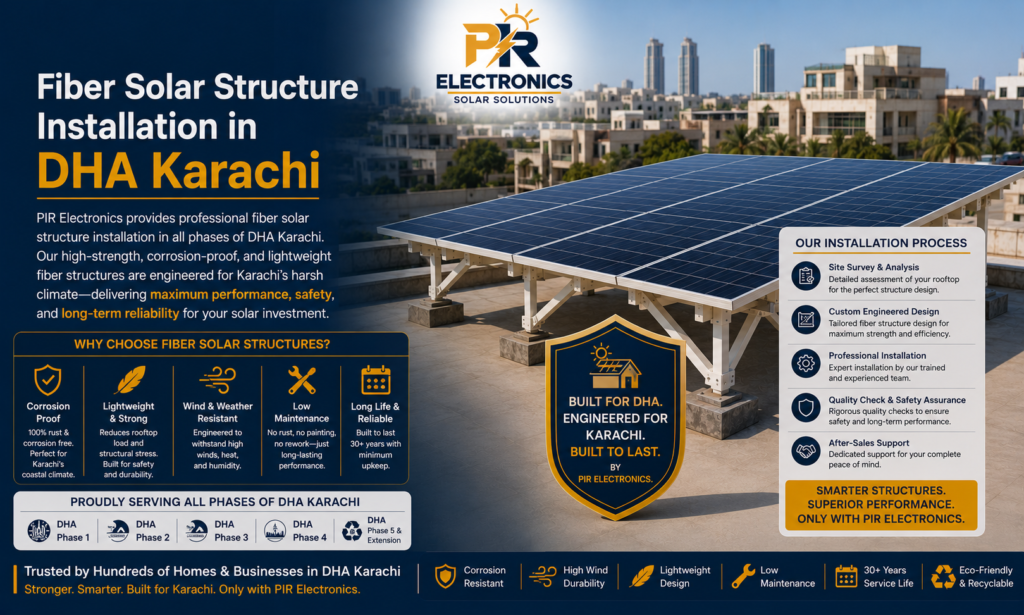
Fiber solar structure Karachi installation Process
A professional solar structure installation DHA project should follow a clear sequence rather than beginning with immediate drilling or fabrication.
1. Rooftop Survey
The process begins with an inspection of the property. The installer should review the roof’s size, condition, access, parapet walls, water tanks, rooms, shade and drainage.
Existing cracks, leakage and weak sections should be documented before installation. This prevents old problems from later being confused with installation damage.
2. Solar Layout Planning
The layout should establish:
- Number of panels
- Panel dimensions
- Direction and tilt
- Distance between rows
- Cleaning access
- Cable routes
- Inverter location
- Clearance from roof edges
- Space around drains and water tanks
A suitable rooftop solar structure DHA Karachi shouldn’t block access to essential building services.
3. Structural Assessment
The installer should assess panel weight, frame weight, structure height, wind exposure, support spacing and anchor requirements.
Elevated structures require particular attention. Greater height may create useful space beneath the panels, but it also increases wind pressure and demands stronger bracing.
4. Fabrication
FRP columns, rails and braces should be cut and prepared according to the approved design. Randomly changing dimensions during installation can affect the complete structure.
The installer must also ensure that fasteners, clamps and connection plates are compatible with the FRP profiles and local conditions.
5. Anchoring and Waterproofing
Anchors transfer structural forces into the roof. Their number, spacing and type should be based on the design rather than convenience.
Any penetration through the roof’s waterproofing layer must be resealed carefully. Poor sealing can cause leakage during rain, even when the solar frame itself remains secure.
6. Frame Assembly
Vertical supports are positioned first, followed by horizontal rails and diagonal braces. The frame must be checked for level, alignment and movement before panels are installed.
Bracing shouldn’t be removed simply to create more open space below the structure. Each brace has a structural purpose.
7. Panel Installation and Handover
Panels are placed on the rails and secured with suitable clamps. Cables should be supported properly rather than left hanging or resting on the roof.
The final inspection should confirm:
- Panel alignment
- Clamp tightness
- Bolt security
- Cable support
- Roof sealing
- Cleaning access
- Drainage clearance
- Overall frame stability
Choosing the Right Height and Tilt
Many DHA homeowners prefer elevated solar structures because the covered area can be used for sitting, parking, storage or general rooftop activity.
However, additional height changes the behaviour of the structure. A tall frame acts more like a canopy and receives greater wind pressure. It may require larger profiles, additional supports, more anchors and stronger diagonal bracing.
Tilt should be selected after considering:
- Solar exposure
- Seasonal sun angle
- Wind resistance
- Row-to-row shading
- Water drainage
- Panel cleaning
- Visual appearance
- Available rooftop area
A neighbouring property’s design shouldn’t automatically be copied. Roof dimensions, building height and exposure may be different.
Factors Affecting Installation Cost
There’s no single fixed price for every solar structure DHA Karachi project. Cost depends on the actual design and site conditions.
Major pricing factors include:
- Total number of solar panels
- FRP profile sizes
- Structure height
- Number of supports and braces
- Roof access
- Anchor type
- Waterproofing work
- Fastener and clamp quality
- Transportation
- Lifting requirements
- Panel mounting
- Warranty and inspection support
A tall 10kW structure may require more material and engineering than a low-profile 15kW installation. Comparing quotations only by kilowatt can therefore be misleading.
A complete quotation should clearly state profile dimensions, structure height, bracing, anchors, fasteners, waterproofing responsibilities and warranty terms.
Common Installation Mistakes to Avoid
Several shortcuts can reduce the safety and lifespan of a solar structure:
- Installing without inspecting the roof
- Using undersized profiles
- Reducing the number of supports
- Removing diagonal braces
- Placing anchors in weak roof sections
- Leaving drilled areas unsealed
- Blocking drainage channels
- Installing panels too close together
- Ignoring cleaning access
- Leaving cables unsupported
- Using low-quality clamps
- Building excessive height without calculations
These problems may not become obvious immediately. Movement, corrosion, leakage and misalignment can develop months after installation.
Selecting a Solar Structure Installer
Before approving an installer, ask for a site survey, layout, material specifications and complete written quotation. The provider should explain why particular profiles, anchors and braces have been selected.
Property owners can consult PIR Electronics for fiber Solar Structure DHA Karachi planning and installation in Karachi.
Ask the installer to clarify:
- FRP profile dimensions
- Material grade
- Structure height
- Support spacing
- Bracing arrangement
- Fastener specifications
- Waterproofing process
- Installation timeline
- Workmanship warranty
- Post-installation inspection
Clear documentation makes quotations easier to compare and reduces the chance of misunderstandings.
Maintenance After Installation
An FRP structure may resist rust, but it shouldn’t be ignored after installation. Owners should inspect the complete frame at least annually and after severe storms.
The inspection should cover:
- Loose bolts or clamps
- Cracked profiles
- Frame movement
- Panel vibration
- Damaged anchors
- Roof leakage
- Misalignment
- Cable deterioration
- Debris around supports
- Blocked drains
Any unusual vibration, movement or noise during windy weather should be investigated promptly. Homeowners shouldn’t climb onto elevated frames or attempt structural modifications without proper safety arrangements.
Final Thoughts
Choosing the right solar structure DHA Karachi solution is essential for protecting panels, rooftops and long-term energy production. DHA’s coastal location makes corrosion resistance, wind stability, anchoring and waterproofing particularly important.
A properly engineered fiber structure can offer lower weight, resistance to rust, electrical insulation and reduced surface maintenance. However, the material alone doesn’t guarantee a successful installation. Roof assessment, correct profile selection, diagonal bracing, dependable anchors and careful workmanship remain essential.
Property owners should compare complete designs rather than focusing only on price per kilowatt. A strong solar investment starts with panels and an inverter, but it depends on a secure structure designed for Karachi’s real environmental conditions.
More Related Posts: Cost Comparision
Frequently Asked Questions
1. Is a fiber solar structure Karachi suitable?
Yes, a properly designed FRP structure can suit DHA Karachi’s humid and coastal environment. It offers resistance to rust and can reduce rooftop weight. Its safety still depends on suitable profiles, anchoring, bracing and professional installation.
2. Is an FRP structure stronger than steel?
FRP and steel behave differently. FRP can provide a high strength-to-weight ratio and corrosion resistance, while steel offers established structural characteristics. A valid comparison depends on material grade, profile dimensions, connection design and expected loads.
3. How long does fiber solar structure installation DHA take?
A small residential structure may take a few days after fabrication, while larger or elevated projects can take longer. Roof condition, access, panel count, design complexity, weather and waterproofing requirements affect the schedule.
4. Does a fiber solar structure Karachi require maintenance?
Yes. FRP profiles may not need regular anti-rust painting, but clamps, bolts, anchors, waterproofing, cables and panel alignment still require periodic inspection.