
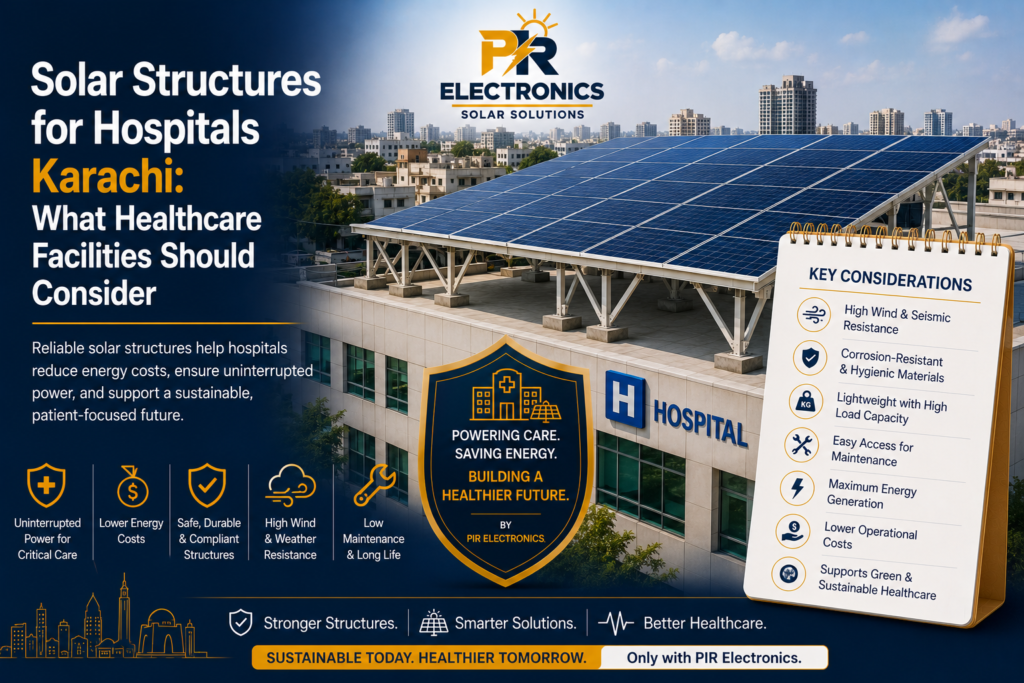
Hospitals operate around the clock. Lighting, ventilation, laboratories, lifts, security systems, and IT networks all depend on reliable electricity. Solar can reduce daytime grid demand, but healthcare rooftops require careful planning.
A successful solar structures for hospitals Karachi project must consider structural capacity, rooftop equipment, wind exposure, maintenance access, drainage, and corrosion. The structure should support solar generation safely.
Table of Contents
Why Hospital Rooftops Need Special Planning
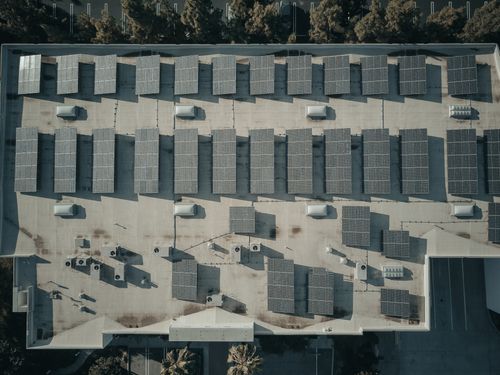
Hospital rooftops may contain water tanks, HVAC units, exhaust systems, communication equipment, lift rooms, and service pathways.
Hospital solar mounting should begin with a detailed site survey. The aim is not simply to fit the maximum number of panels. Designers need to identify areas where modules can be installed while preserving access to equipment that may need urgent repair.
Structural Capacity Comes First
Before installing any solar frame, the roof and supporting structure should be assessed. Hospitals may have undergone extensions, equipment upgrades, or rooftop modifications over time.
The assessment should review roof condition, structural members, mechanical equipment, water tanks, mounting areas, and signs of leakage or cracking.
Rooftop solar structures should be designed around the building rather than copied from another project.
Keep Maintenance and Emergency Access Clear
A tightly packed solar array may increase capacity but make future maintenance difficult.
If technicians cannot reach an HVAC unit, water tank, electrical service point, or fire-safety component, the solar layout has created an operational problem.
Hospital solar mounting should leave defined pathways. Solar technicians also need room to clean modules, inspect clamps, check cables, and replace panels safely.
Wind Exposure Matters
Elevated rooftop arrays can experience significant wind forces, especially on large or multi-storey buildings.
Panel tilt, frame height, roof edges, parapets, and nearby structures can influence wind behaviour.
Wind-resistant rooftop solar structures need suitable bracing, anchors, connections, and support spacing. Raising a frame to clear equipment can increase structural demand, so height should not be changed during installation without reviewing the design.
Why Lightweight Materials May Help
Hospital roofs may already carry heavy mechanical equipment. Reducing unnecessary additional dead load can therefore be useful.
FRP solar structures may be considered where low weight, corrosion resistance, and electrical non-conductivity are valuable. Fiber-reinforced polymer does not rust through the same process as conventional carbon steel.
However, FRP should not be selected based only on weight. Profile dimensions, resin quality, UV exposure, fire requirements, connections, bracing, and expected loads still need assessment.
Plan for Long-Term Maintenance
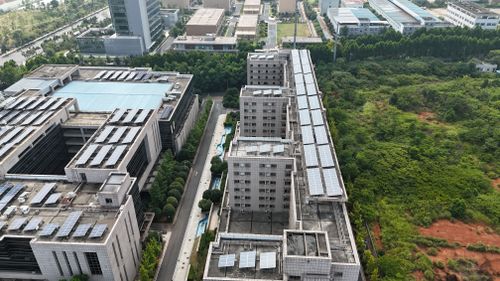
Hospitals are long-life facilities, so solar mounting systems should be selected with maintenance in mind.
Steel structures may require attention to damaged coatings, bolts, and exposed connections. FRP solar structures reduce conventional rust concerns, but clamps, anchors, and interfaces still require inspection.
Maintenance should check loose fasteners, panel movement, damaged braces, cable supports, waterproofing, and drainage around mounting bases.
No mounting system should be considered maintenance-free.
Drainage Must Stay Functional
Hospital roofs need dependable drainage during heavy rain.
Solar columns, rails, and mounting bases should not block drains or create areas where water can collect. Debris can also become trapped beneath the array.
A good commercial solar structures Karachi design should keep drains accessible and allow routine roof cleaning. Standing water near electrical components or roof penetrations can create avoidable problems.
Protect Rooftop Equipment and Airflow
Solar panels should not interfere with HVAC units, exhaust outlets, communication equipment, or other essential rooftop systems.
Hospitals depend heavily on ventilation and cooling. These units need adequate airflow and enough clearance for technicians to service them.
The solar layout should therefore be coordinated with the facility team before installation.
Think About Future Expansion
Hospitals may add equipment or rooftop services over time. Where possible, designers should reserve space for future panels so expansion does not require expensive structural redesign.
What Hospital Management Should Ask
Before approving a solar mounting proposal, management should ask:
- Has the roof been professionally surveyed?
- Are service pathways protected?
- How has wind exposure been considered?
- What additional roof load will be created?
- Which mounting material is proposed?
- Are drains accessible?
- Can HVAC equipment be serviced?
- Can the system expand later?
A technical proposal is more valuable than choosing only by the lowest price per kilowatt.
How PIR Electronics Can Support Hospital Projects
PIR Electronics provides site surveys, feasibility planning, FRP solar mounting structures, structure installation, and panel mounting services in Karachi.
For healthcare facilities, design should begin with the actual roof, equipment, access requirements, and structural limitations.
The objective is a mounting solution that supports solar generation while allowing maintenance teams to work safely around essential infrastructure.
Final Thoughts
Hospitals can benefit from solar energy, but their rooftops demand careful planning.
Successful solar structures for hospitals Karachi projects combine structural assessment, safe access, wind-aware design, corrosion planning, drainage, cable management, and future flexibility.
For healthcare facilities, the best mounting system supports reliable solar generation without interfering with essential operations.
Planning solar for a hospital in Karachi? Contact PIR Electronics for a site survey and mounting-structure feasibility assessment.
FAQs
Can Hospitals Install Solar Panels on Existing Roofs?
Yes, if the roof and supporting structure are suitable and access to critical equipment remains protected.
Are FRP Solar Structures Suitable for Hospitals?
They can be suitable where low weight and corrosion resistance are important, but the complete design must meet project requirements.
Can Panels Be Installed Around HVAC Equipment?
Yes, but adequate airflow and service clearance must remain available.
Do Hospital Solar Structures Need Regular Inspection?
Yes. Clamps, bolts, anchors, cables, drainage, and visible structural condition should be checked periodically.
Can Hospital Solar Systems Be Expanded Later?
Often yes, if roof capacity, structure design, inverter limits, and available space are reviewed first.